Thursday, June 19, 2025

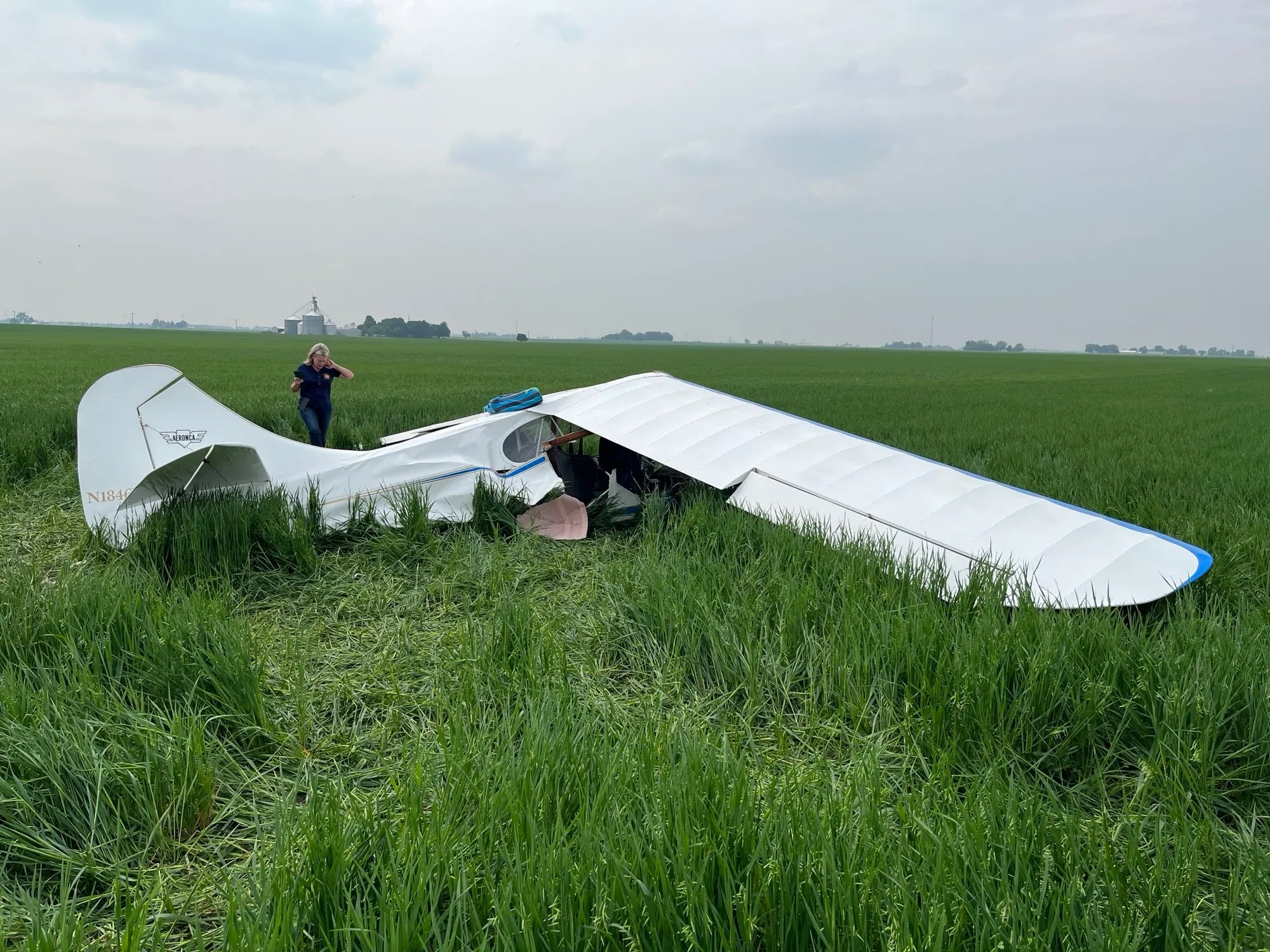
Aeronca 7AC Champion, N1846E , fatal accident occurred on June 7, 2025, near Hinkley Airport (0C2), Waterman, Illinois

  • Location: Waterman, IL 
  • Accident Number: CEN25FA198 
  • Date & Time: June 7, 2025, 14:59 Local 
  • Registration: N1846E 
  • Aircraft: Aeronca 7AC 
  • Injuries: 1 Fatal, 1 Serious 
  • Flight Conducted Under: Part 91: General aviation - Personal
https://data.ntsb.gov/carol-repgen/api/Aviation/ReportMain/GenerateNewestReport/200281/pdf

https://registry.faa.gov/AircraftInquiry/Search/NNumberResult?NNumberTxt=N1846E

On June 7, 2025, about 1459 central daylight time, an Aeronca 7AC airplane, N1846E, sustained substantial damage when it was involved in an accident near Waterman, Illinois. The pilot was fatally injured, and the passenger was seriously injured. The airplane was operated as a Title 14 Code of Federal Regulations Part 91 personal flight. 

According to witness reports, the pilot took his 3-year-old grandson for a ride to drop a homemade parachute made from a 16 ounce water bottle in a plastic grocery bag suspended below a homemade parachute made from black plastic. The parachute was dropped and the pilot reported over the radio that he was coming back around to see where the parachute landed. Witnesses observed the airplane maneuvering just west of the airport property; the right wing dipped, the nose dropped into a sudden dive, and an increase in engine power was heard. The wings leveled but the dive was not arrested before the airplane impacted terrain. 

The airplane came to rest about 250 ft west of the Hinkley Airport (0C2), Hinkley, Illinois, property in a cultivated field. The top cowl over the engine was at a 37° nose down angle to the ground with the engine at the same attitude. The top portion of the fuselage from the firewall aft was deformed to the left. The left wing was in line with its normal position but with the fuselage deformity the left wing struts laid flat on the ground. The right wing remained attached to the fuselage, but the right wing struts exhibited impact damage, and the wing was angled downward with its wingtip nearly resting on the ground. All three landing gear separated from the airplane and the fuel tank was ejected about 10-15 feet forward of the airplane. 

The airplane, engine, and propeller were examined at the accident site and no anomalies were found that would have prevented normal operation of the airplane.

Express 2000 FT, N519EA, fatal accident occurred on May 5, 2025, near Polk, Ohio

  • Location: Polk, OH 
  • Accident Number: ERA25FA195 
  • Date & Time: May 5, 2025, 19:40 Local 
  • Registration: N519EA 
  • Aircraft: FFF LLC EXPRESS 2000 FT 
  • Injuries: 1 Fatal 
  • Flight Conducted Under: Part 91: General aviation - Personal
https://data.ntsb.gov/carol-repgen/api/Aviation/ReportMain/GenerateNewestReport/200109/pdf

https://registry.faa.gov/AircraftInquiry/Search/NNumberResult?nNumberTxt=N519EA

On May 5, 2025, about 1940 eastern daylight time, an experimental, amateur-built FFF LLC Express 2000 FT airplane, N519EA, was substantially damaged when it was involved in an accident near Polk, Ohio. The pilot was fatally injured. The airplane was operated as a Title 14 Code of Federal Regulations Part 91 personal flight. 

On April 27, 2025, the pilot flew from Delphi Municipal Airport (1I9), Delphi, Indiana, where he hangared the airplane, to Burke Lakefront Airport (BKL), Cleveland, Ohio, to visit a family member. 

According to preliminary radar data, automatic dependent surveillance-broadcast (ADS-B) data, and air traffic control (ATC) audio recordings provided by the Federal Aviation Administration (FAA), on the date of the accident, the airplane departed BKL about 1857 under visual flight rules to return to 1I9. 

ADS-B data subsequently indicated that the airplane was in cruise flight at 3,000 ft above mean sea level when its flight path became erratic, displaying irregular changes in altitude, heading, and airspeed. This continued until the end of the ADS-B flight track (see figure 1).


The area where the airplane’s flight path became erratic was within an area consistent with heavy precipitation. A Cleveland (CLE) radar controller attempted to contact the airplane via multiple frequencies, with no response. Subsequently, the Mansfield (MFD) local controller (LC) established communication with the pilot who stated that he was trying to land at Ashland County Airport (3G4), Ashland, Ohio. At that time, the airplane was at 3,800 ft. The MFD LC asked the pilot for a pilot report and if he needed any assistance. The pilot reported a rough ride and expressed difficulty with controlling the airplane. The MFD LC then suggested that he fly southbound. There was no response from the pilot. 

Radar contact with the airplane was lost shortly thereafter when it was at an altitude of 2,600 ft. 

The wreckage was subsequently found in a wooded area near a farmer’s field approximately 3.3 nautical miles northeast of 3G4. 

Examination of the accident site and wreckage indicated that the airplane struck a tree limb and then impacted terrain in an approximate 15° nose low attitude while in a right turn. There was no evidence of an inflight fire, explosion, or structural failure, and all the primary flight control surfaces (ailerons, elevator, and rudder), remained attached to their mounts. The wing flaps were up. 

Both the left and right fuel tank caps were in place; however, both fuel tanks were breached, and the odor of aviation gasoline was present.

The baggage door, the left cabin door, and right cabin door had separated from their mounts during the impact sequence, and the empennage was almost completely separated from the aft fuselage. 

The engine throttle was full open, the propeller control was in the “HIGH RPM” position, and the mixture control was slightly lean of rich (about ½ travel, between “LEAN and “RICH”). The fuel selector was in the detent for the “RIGHT” fuel tank. 

The propeller and engine were recovered from about 3 ft below ground level. The engine was almost completely separated from its mounting position forward of the firewall and was canted downward. The propeller was separated from the crankshaft and canted to the right of the engine centerline. 

At 1943, the weather reported at Wayne County Airport (BJJ), Wooster, Ohio, which was located about 15 nautical miles from the accident site, indicated that the wind was from 270° at 15 knots with gusts to 21 knots, visibility 4 miles, moderate rain and thunderstorms, mist, overcast ceiling at 4,000 ft above ground level, temperature of 11°C, dew point temperature of 9°C, and an altimeter setting of 29.92 inHg. Peak wind was from 210° at 40 knots at 1904, and a wind shift had occurred at 1902. There was lightning in the distant west through northeast, and rain began at 1906. A thunderstorm began at 1908, and 0.86 inches of precipitation had occurred since 1856. 

Review of the National Weather Service (NWS) National Reflectivity Mosaic for 1940, depicted echoes of 20 to 60 dBZ in the area around the accident site (see figure 2).


There was a Convective SIGMET valid for the accident site at the accident time issued by the Aviation Weather Center (AWC). SIGMET 96E issued at 1855, valid through 2055, forecast an area of severe thunderstorms with tops to FL410, hail to 1.5 inches, and wind gusts to 60 knots possible. 

According to FAA and airplane maintenance records, the airplane received its special airworthiness certificate on June 22, 2017. The airplane's most recent condition inspection was completed on September 6, 2024. At the time of the inspection, the airplane had accrued approximately 347 total hours of operation, and the engine had accrued 467 total hours of operation. 

According to FAA and pilot records, the pilot held a private pilot certificate with ratings for airplane single-engine land, and rotorcraft-helicopter. He did not possess an instrument rating. His FAA BasicMed course was completed on July 4, 2024, and his BasicMed comprehensive medical examination checklist was completed on July 26, 2022. He had accrued about 622 total flight hours, about 412 of which were in the accident airplane make and model. 

The wreckage was retained for further examination.
Wednesday, June 18, 2025

Landing gear not configured: Beechcraft A35 Bonanza, N691B, accident occurred on February 11, 2024, at Ak-Chin Regional Airport (A39), Maricopa, Arizona:


  • Location: Maricopa, Arizona
  • Accident Number: WPR24LA086 
  • Date & Time: February 11, 2024, 10:30 Local 
  • Registration: N691B 
  • Aircraft: Beech A35 
  • Aircraft Damage: Substantial 
  • Defining Event: Landing gear not configured 
  • Injuries: 3 None 
  • Flight Conducted Under: Part 91: General aviation - Personal
https://data.ntsb.gov/carol-repgen/api/Aviation/ReportMain/GenerateNewestReport/193781/pdf

https://data.ntsb.gov/Docket?ProjectID=193781

On February 11, 2024, at 1030 mountain standard time, a Beech A35, N619B, was substantially damaged when it was involved in an accident near Maricopa, Arizona. The pilot and two passengers were not injured. The airplane was operated as a Title 14 Code of Federal Regulations Part 91 personal flight.

The pilot stated that she put the landing gear switch in the down position when the airplane was midfield on the downwind leg of the traffic pattern and lowered the flaps on the base turn. The pilot also stated that she did not look at the gear position indicator before landing. Security video captured the airplane on short final, and the landing gear appeared to be in the retracted position. The airplane subsequently landed gear-up, substantially damaging the fuselage.

Following the accident, the landing gear switch was found in the down position, and the main landing gear doors were partially extended, with the inboard edges of the doors contacting the ground. Postaccident examination revealed no damage to the left main landing gear door, scraping damage to the extended ridge on the right main landing gear door, and scraping damage to the aft and outboard edges of the nose gear doors. The observed damage was consistent with all the landing gear being fully retracted upon landing. An operational check of the landing gear system revealed no anomalies. 

The accident is consistent with the pilot's failure to configure the landing gear and to verify its position before landing.

- Probable Cause: The pilot's failure to properly configure the landing gear and verify its position before landing, which resulted in a gear-up landing.

Dynamic rollover: Bell 505 Jet Ranger X, N9TV, accident occurred on April 30, 2025, at Wiley Post Airport (PWA/KPWA), Oklahoma City, Oklahoma


  • Location: Bethany, Oklahoma 
  • Accident Number: CEN25LA167 
  • Date & Time: April 30, 2025, 17:52 Local 
  • Registration: N9TV 
  • Aircraft: BELL HELICOPTER TEXTRON CANADA 505 
  • Aircraft Damage: Substantial 
  • Defining Event: Dynamic rollover 
  • Injuries: 1 Minor, 1 None 
  • Flight Conducted Under: Part 91: General aviation - Business

https://data.ntsb.gov/carol-repgen/api/Aviation/ReportMain/GenerateNewestReport/200106/pdf

https://data.ntsb.gov/Docket?ProjectID=200106

After completing a two-hour news gathering flight, the pilot returned to the airport and attempted to land on a dolly landing platform. The pilot stated that he landed off-center on the platform, then attempted to back out and straighten the helicopter. The helicopter’s right skid got caught in the middle of the platform, and the helicopter rolled right and experienced a dynamic rollover, which resulted in substantial damage. The pilot reported that there were no preaccident mechanical malfunctions or failures of the helicopter that would have precluded normal operation.

- Probable Cause: The pilot’s improper landing technique that allowed the helicopter’s right skid to get caught on the landing platform, which resulted in a dynamic rollover.

Landing gear not configured: Beechcraft B95A Travel Air, N755RP, accident occurred on December 19, 2024, at Murray-Calloway County Airport (CEY/KCEY), Murray, Kentucky

  • Location: Murray, Kentucky 
  • Accident Number: ERA25LA083 
  • Date & Time: December 19, 2024, 15:50 Local 
  • Registration: N755RP 
  • Aircraft: Beech B95A 
  • Aircraft Damage: Substantial 
  • Defining Event: Landing gear not configured 
  • Injuries: 2 None 
  • Flight Conducted Under: Part 91: General aviation - Instructional
https://data.ntsb.gov/carol-repgen/api/Aviation/ReportMain/GenerateNewestReport/199459/pdf

https://data.ntsb.gov/Docket?ProjectID=199459

The pilot was completing his multi-engine checkride with a Designated Pilot Examiner (DPE). The DPE had configured the airplane for a simulated single-engine landing. The DPE recalled the pilot calling out an extension of the landing gear, but the pilot did not remember putting the landing gear down and nor verifying that it was extended. Neither pilot nor DPE recalled hearing the landing gear position warning horn before touchdown. The airplane touched down on the runway with the landing gear retracted and slid down the runway on the underside of the fuselage, substantially damaging it.


A postaccident examination of the landing gear system revealed that the landing gear position warning horn was functioning normally. Neither pilot reported that there were any preimpact mechanical malfunctions or failures with the airplane were reported that would have precluded normal operation.


- Probable Cause: The pilot’s failure to lower the landing gear before touchdown, which resulted in a gear-up landing. Contributing was the designated pilot examiner’s inadequate monitoring and lack of remedial action. 

Robinson R22 Mariner, N178EP, accident occurred on November 13, 2025, near Parrottsville, Tennessee

  • Location: Parrottsville, Tennessee 
  • Accident Number: ERA25LA046 
  • Date & Time: November 13, 2024, 11:30 Local 
  • Registration: N178EP
  • Aircraft: ROBINSON HELICOPTER COMPANY R22 MARINER 
  • Aircraft Damage: Substantial 
  • Defining Event: Loss of control in flight 
  • Injuries: 1 Minor 
  • Flight Conducted Under: Part 91: General aviation - Instructional

https://registry.faa.gov/AircraftInquiry/Search/NNumberResult?NNumberTxt=178EP

https://data.ntsb.gov/carol-repgen/api/Aviation/ReportMain/GenerateNewestReport/195496/pdf

https://data.ntsb.gov/Docket?ProjectID=195496

The student pilot of the helicopter stated she was flying on her first solo cross-county flight. She flew to the first destination airport, which was about 30 minutes away, and made three uneventful approaches to land before departing the airspace and fly to another airport and practice some more approaches. She stated that about 15 minutes out from the next airport, she was having problems getting the correct frequency dialed into the radio and the helicopter felt “light” on the controls. She further described that the engine was running normally and all engine controls were functioning as expected. She then decided to make a precautionary landing in a field. During landing, she was focused on the helicopter’s instruments, did not look outside at the ground, and did not notice the field was slopped. One of the helicopter’s skids contacted the ground with a sideways motion, and the helicopter began to spin. The tail rotor subsequently contacted the ground and the helicopter rolled over on its left side resulting in substantial damage to the tail rotor and tail boom. The pilot stated that there were no preimpact mechanical malfunctions or failures of the helicopter that would have precluded normal operation.


- Probable Cause: The pilot’s failure to maintain control of the helicopter during a precautionary, off-airport landing to sloping terrain.

AC/prop/rotor contact w person: Aero AT-4 LSA, N401G, accident occurred on October 25, 2024, at Mallory Airport (WV12), South Charleston, West Virginia

  • Location: South Charleston, West Virginia 
  • Accident Number: ERA25LA032 
  • Date & Time: October 25, 2024, 11:30 Local 
  • Registration: N401G 
  • Aircraft: AERO SP Z O O AT-4 LSA 
  • Aircraft Damage: Minor 
  • Defining Event: AC/prop/rotor contact w person 
  • Injuries: 1 Serious, 2 None 
  • Flight Conducted Under: Part 91: General aviation - Instructional
https://registry.faa.gov/AircraftInquiry/Search/NNumberResult?nNumberTxt=N401G

https://data.ntsb.gov/carol-repgen/api/Aviation/ReportMain/GenerateNewestReport/195416/pdf

https://data.ntsb.gov/Docket?ProjectID=195416

At the conclusion of a short cross-country flight, the flight instructor and student pilot elected to a perform takeoff and landings at their destination airport. The airport was privately owned, the single asphalt runway was 1,900 ft-long by 24 ft-wide, and there was no taxiway parallel to the runway. The flight instructor stated that, he scanned the runway for obstructions and announced over the airport’s Common Traffic Advisory Frequency the airplane’s position in the traffic pattern and their intent to land. No obstructions were observed during the landing. As the pilots taxied the airplane down the recently-paved runway, a person wearing dark-colored clothing “suddenly” came into view. The person was walking along the runway with his back toward the approaching airplane. The airplane’s left wingtip contacted the pedestrian and knocked him forcefully to the ground, resulting in serious injuries. The airplane’s wingtip incurred minor damage. The flight instructor then stopped the airplane, and he and the student rendered aid to the pedestrian until emergency responders arrived. The flight instructor reported that the pedestrian typically carried a hand-held radio that he would use to listen for traffic calls, but he was not carrying it with him on the day of the accident.


- Probable Cause: The pedestrian’s inadequate visual lookout while walking next to an active runway, which resulted in the airplane striking him during taxi.