Wednesday, June 25, 2025

Cessna R182 Skylane RG, N262AL, incident occurred on June 23, 2025, at Peter Prince Field (2R4), Milton, Florida

This is preliminary information, subject to change, and may contain errors. Any errors in this report will be corrected when the final report has been completed.

https://registry.faa.gov/AircraftInquiry/Search/NNumberResult?nNumberTxt=N262AL

Dale County Sheriffs Office

On June 23, 2025, at about 0935 local time, a Cessna R182 Skylane RG, N262AL, registered to the Dale County Sheriffs Office out of Ozark, Alabama, sustained unknown damage when it was involved in an accident at Peter Prince Field (2R4), Milton, Florida. The pilot was not injured.

The FAA reported that the airplane lost power on takeoff and crashed past the departure end of the runway.

Piper PA-36-375 Brave, N6174A, accident occurred on June 19, 2025, near Huron, South Dakota

This is preliminary information, subject to change, and may contain errors. Any errors in this report will be corrected when the final report has been completed.

https://registry.faa.gov/AircraftInquiry/Search/NNumberResult?nNumberTxt=N6174A

Dakota Air Spray LLC

On June 19, 2025, at about 0940 local time, a Piper PA-36-375 Brave, N6174A, was destroyed when it was involved in an accident near Huron, South Dakota. The pilot was not injured. The airplane was operated as an agricultural flight conducted under the provisions of Title 14 Code of Federal Regulations Part 137.

The FAA reported that the airplane crashed in a field for unknown reasons.


NTSB Investigation: YES (CEN25LA218)

Murphy Moose, N250MK, fatal accident occurred on June 23, 2025, near Montrose Regional Airport (MTJ/KMTJ), Montrose, Colorado

 This is preliminary information, subject to change, and may contain errors. Any errors in this report will be corrected when the final report has been completed.

https://registry.faa.gov/AircraftInquiry/Search/NNumberResult?nNumberTxt=N250MK

Figure 1: Wreckage

On June 23, 2025, at about 1000 local time, a privately-registered Murphy Moose, N250MK, was destroyed when it impacted terrain near Montrose Regional Airport (MTJ/KMTJ), Montrose, Colorado. The pilot and passenger were fatally injured. The The airplane was operated as a Title 14 Code of Federal Regulations CFR Part 91 personal flight, which originated from MTJ, and was destined to an unknown location.

A witness reported seeing the aircraft in a right turn after takeoff until it hit an embankment, overturned and caught fire. It is still not confirmed which runway was used for takeoff.

- Pilot Info:
The pilot, aged 61, held an airline transport pilot certificate, with a rating for airplane single engine land and airplane multi-engine land. He also held commercial privileges for airplane single engine sea. He also held a flight instructor certificate (valid until 31 MAR 2026) and airframe and powerplant (A&P) certificate. The pilot held type ratings in the Boeing 757, Boeing 767 and Douglas DC-8. The pilot's first class FAA medical was issued on February 2025, with a note about wearing corrective lenses to meet vision standards at all required distances.

- Airplane Info:
The accident airplane, MSN 001, was manufactured in 2008. It was powered by a Vedeneyev M14P engine. According to the FAA registry, "This aircraft's registration status may not be suitable for operation." It is unknown if this is outdated or not.

- Airport Info:
Montrose Regional Airport is a public airport located about 1 mile northwest of Montrose, Colorado. The airport sits at an elevation of 5758 ft. It features two asphalt runways 17/35 (10000 x 150 ft) and 13/31 (7510 x 100 ft).

- Weather:
METAR KMTJ 231553Z AUTO 30007KT 10SM CLR 19/M04 A3017 RMK AO2 SLP145 T01891039
METAR KMTJ 231653Z AUTO 31006KT 10SM CLR 21/M02 A3016 RMK AO2 SLP139 T02061017

The density altitude was calculated at 7338 ft.

Van’s RV-9, N696WG, accident occurred on June 23, 2025, near Morgan Hill, California

This is preliminary information, subject to change, and may contain errors. Any errors in this report will be corrected when the final report has been completed.

https://registry.faa.gov/AircraftInquiry/Search/NNumberResult?nNumberTxt=N696WG

Figure 1: ADS-B Exchange

On June 23, 2025, at about 1218 local time, a privately-registered Van's RV-9, N696WG, sustained substantial damage in a forced landing near Morgan Hill, California. The pilot received minor injuries. The pilot was not injured. The airplane was operated as a Title 14 Code of Federal Regulations CFR Part 91 persona flight, which originated from San Carlos Airport (SQL/KSQL), San Carlos, California, at about 1151 LT.


ADS-B data show that the airplane departed runway 30 at KSQL and entered a climbing right turn to an inflight cruising altitude of about 4500 ft. At about 1216 LT, the airplane entered a right turn to the south and began a gradual descent towards the ground. The airplane landed in a field and came to rest nose down. The FAA reported that it experienced a loss of engine power.

Tuesday, June 24, 2025

Piper PA-32RT-300T Turbo Lance II, N130XR, accident occurred on May 30, 2025, near Tulsa International Airport (TUL/KTUL), Tulsa, Oklahoma

  • Location: Tulsa, OK
  • Accident Number: CEN25LA192 
  • Date & Time: May 30, 2025, 16:27 Local 
  • Registration: N130XR 
  • Aircraft: Piper PA-32RT-300T 
  • Injuries: 1 Serious, 1 Minor 
  • Flight Conducted Under: Part 91: General aviation - Personal

https://registry.faa.gov/AircraftInquiry/Search/NNumberResult?nNumberTxt=130XR

https://data.ntsb.gov/carol-repgen/api/Aviation/ReportMain/GenerateNewestReport/200250/pdf

On May 30, 2025, about 1627 central daylight time, a Piper PA-32RT-300T airplane, N130XR, was substantially damaged when it was involved in an accident near Tulsa, Oklahoma. The pilot sustained serious injuries, and the pilot-rated passenger sustained minor injuries. The airplane was operated as a Title 14 Code of Federal Regulations Part 91 personal flight.

The pilot reported that the flight was uneventful until the approach to land at Tulsa International Airport, Tulsa, Oklahoma (TUL). During the approach, the pilot reduced engine power, and the engine lost total power. The pilot switched from the right to the left fuel tank, turned on the electric fuel pump, and performed the emergency checklist procedures. Engine power was restored, and the airplane was able to climb about 100 ft. The pilot attempted to continue the approach, and on short final, he again reduced the engine power and the engine experienced a second complete loss of power.

The pilot executed a forced landing in a field. During the forced landing, the airplane struck powerlines and impacted a roadway. The airplane sustained substantial damage to both wings and the fuselage.

The airplane was retained for further examination.

de Havilland Canada DHC-2 Beaver Mk I (L-20A), N4957, accident occurred on June 10, 2024, near Port Alsworth, Alaska

  • Location: Port Alsworth, Alaska 
  • Accident Number: ANC24LA049 
  • Date & Time: June 10, 2024, 16:35 Local 
  • Registration: N4957 
  • Aircraft: DEHAVILLAND BEAVER L-20A (DHC-2) 
  • Aircraft Damage: Substantial 
  • Defining Event: Unknown or undetermined 
  • Injuries: 1 Serious, 5 None 
  • Flight Conducted Under: Part 91: General aviation - Other work use 

https://data.ntsb.gov/carol-repgen/api/Aviation/ReportMain/GenerateNewestReport/194439/pdf

https://data.ntsb.gov/Docket?ProjectID=194439

On June 10, 2024, about 1635 Alaska daylight time, a float-equipped DeHavilland DHC-2 airplane, N4957, was substantially damaged when it was involved in an accident near Port Alsworth, Alaska. The pilot and four passengers were not injured, and one passenger sustained minor injuries. The airplane was operated as a Title 14 Code of Federal Regulations Part 91 business flight.

The pilot and five passengers departed from a remote lake in the float-equipped airplane. The pilot reported that, shortly after takeoff, he felt the manifold pressure decrease, and he advanced the propeller and throttle controls. The engine initially responded with an increase in rpm and manifold pressure but subsequently lost total power. The pilot performed a forced landing into a heavily wooded area, and the airplane sustained substantial damage to the fuselage and wings.

A postaccident examination of the engine revealed no evidence of preimpact mechanical malfunctions or failures that would have precluded normal engine operation. Passengers reported that the pilot made an aggressive steep turn at low altitude with no change in engine noise from takeoff to impact with terrain. Based on available evidence, it is likely that the engine sustained a partial loss of engine power for reasons that could not be determined.

- Probable Cause: A partial loss of engine power for reasons that could not be determined.

Icon A5, N239BA, fatal accident occurred on June 30, 2023, near Onamia, Minnesota

  • Location: Onamia, Minnesota 
  • Accident Number: CEN23FA270 
  • Date & Time: June 30, 2023, 13:49 Local 
  • Registration: N239BA 
  • Aircraft: ICON A5 
  • Aircraft Damage: Destroyed 
  • Defining Event: Controlled flight into terr/obj (CFIT) 
  • Injuries: 1 Fatal 
  • Flight Conducted Under: Part 91: General aviation - Personal
https://data.ntsb.gov/carol-repgen/api/Aviation/ReportMain/GenerateNewestReport/192494/pdf

https://data.ntsb.gov/Docket?ProjectID=192494

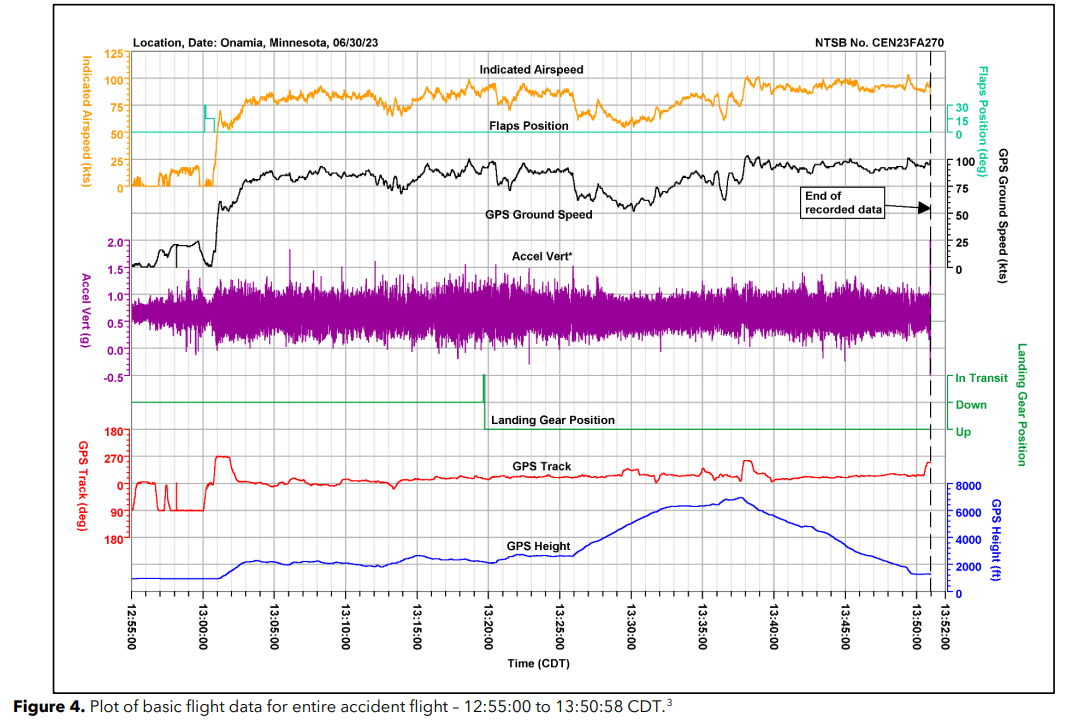
On June 30, 2023, about 1349 central daylight time, an Icon A5 airplane, N239BA, was destroyed when it was involved in an accident on Mille Lacs Lake near Onamia, Minnesota. The pilot was fatally injured. The airplane was operated as a Title 14 Code of Federal Regulations Part 91 personal flight. 

The flight of two airplanes was in cruise flight on a north heading about 50 ft above a lake when the pilots agreed to fly closer to the west shore of the lake. The pilot of the second (nonaccident) airplane initiated a climb and turned toward  he west. In his peripheral vision, he noticed a splash and thought the pilot of the amphibious light sport airplane had landed on the water. He made several radio calls to the accident pilot with no response.

A witness reported seeing both airplanes fly about 30–40 ft above the surface of the water; however, they did not see the accident. The airplane was destroyed when it impacted the water and became submerged in about 26 ft of water. Examination of the wreckage indicated that the airplane impacted water in a left-wing-low attitude. Further examination revealed no evidence of preimpact failures or malfunctions that would have precluded normal operation. Damage to the propeller indicated that the engine was likely under power at the time of the accident.

The pilot’s autopsy revealed cardiovascular disease that would have increased his risk of experiencing a sudden impairing or incapacitating cardiac event, such as arrhythmia, chest pain, or heart attack. There was no autopsy evidence that such an event occurred; however, such an event does not leave reliable autopsy evidence if it occurs shortly before death.

Toxicology results indicated that the pilot had used a cannabis product. However, the precise timing of his last cannabis use, and whether it caused significant impairing effects at the time of the accident, could not be determined from the measured levels of delta-9-THC and its metabolites.

- Probable Cause: The pilot’s failure to maintain clearance from the water while flying at a low altitude.