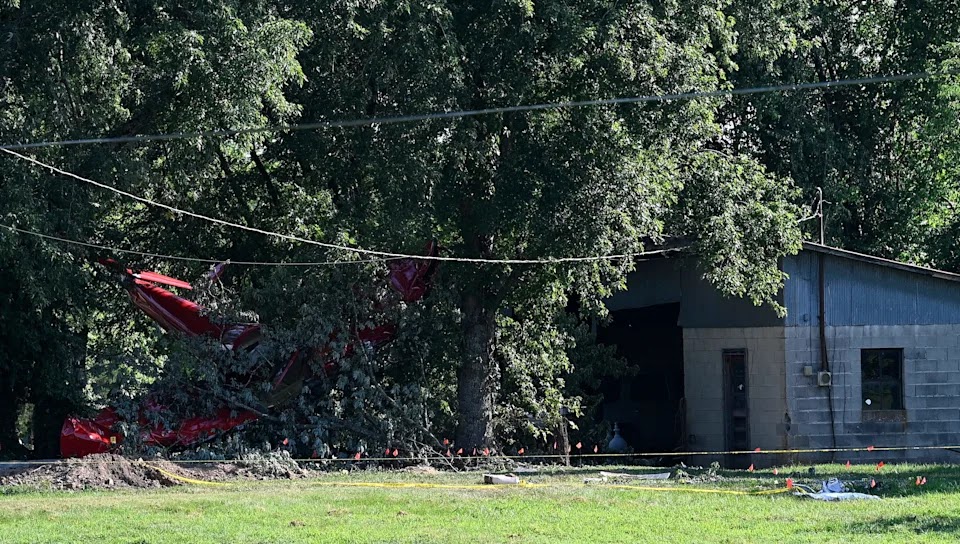
- Location: Grady, AR
- Accident Number: CEN25FA197
- Date & Time: June 6, 2025, 18:30 Local
- Registration: N9185F
- Aircraft: AIR TRACTOR INC AT-502
- Injuries: 1 Fatal
- Flight Conducted Under: Part 137: Agricultural
I used to run the "Aviation Accidents/This Day in History" Facebook page (also known as the Junior GA Reporter) from 2017 until late 2024. Early coverage for all incidents and accidents on US soil, more detailed coverage for fatal and more serious events. On-time NTSB preliminary report posting and run downs of daily FAA reports. Occasional NTSB final report posting. Not monetized and I don't plan to do that anytime soon, if ever.
Friday, July 18, 2025
Air Tractor AT-502, N9185F, fatal accident occurred on June 6, 2025, near Grady, Arkansas
Zenith CH601DS Zodiac, N314LB, fatal accident occurred on July 12, 2025, in the Pawnee National Grassland, Colorado
- Location: Pawnee National Grassland, CO
- Accident Number: CEN25FA247
- Date & Time: July 12, 2025, 12:50 Local
- Registration: N314LB
- Aircraft: Zenith CH601
- Injuries: 1 Fatal
- Flight Conducted Under: Part 91: General aviation - Personal
https://data.ntsb.gov/carol-repgen/api/Aviation/ReportMain/GenerateNewestReport/200516/pdf
https://registry.faa.gov/AircraftInquiry/Search/NNumberResult?nNumberTxt=N314LB
On July 12, 2025, about 1250 mountain daylight time, a Zenith CH601 HDS airplane, N314LB was destroyed when it was involved in an accident in the Pawnee National Grasslands, Colorado. The pilot was fatally injured. The airplane was operated under the provisions of Title 14 Code of Federal Regulations Part 91 as a personal flight.
According to the pilot’s son, the airplane departed Rexburg-Madison Airport, Rexburg, Idaho, early in the morning on July 12th. The airplane landed at Central Wyoming Regional Airport (RIW) Riverton, Wyoming, and the pilot refueled the airplane. The airplane departed RIW and was enroute to Goodland, Kansas, where the pilot planned to spend the night.
According to ADS-B data, the airplane was primarily on a southeast heading when the airplane turned south and began a descent during the last 90 seconds of recorded data. A witness, located at the accident site, stated the airplane descended in a wings level and nose low attitude, and the engine was running at what sounded like a full throttle setting. The witness also stated that as the airplane got closer to the ground, the pitch attitude of the airplane did not change. The nose of the airplane remained in a nose low attitude pointed toward the ground. The witness said the airplane struck the ground, bounced twice, and came to rest upright.
The accident site was located on a sloping grassy prairie about 24 nm northeast of Greeley-Weld County Airport (GXY), Greeley, Colorado. The initial impact was on a magnetic heading of about 240°. The airplane traveled 293 ft from initial impact until the main wreckage came to rest on a magnetic heading of about 305°. The debris field was about 475 ft long and 125 ft wide. Preceding the main wreckage were pieces of wheel fairings, navigation lights, the right wing tip, top of the cowling, and a lower portion of the right wing. The landing gear and the engine were furthest away from the main wreckage. The nose landing gear was about 55 ft east of the main wreckage, the left main landing gear was about 85 ft southeast of the main wreckage, and the right main landing gear was about 75 ft southwest of the main wreckage. The engine was 175 ft southeast of the main wreckage.
Control cable continuity was confirmed from the elevator to the control stick and full range of motion was achieved. Both the elevator control cable and the elevator balance cable remained intact and connected to the control stick.
Full range of rudder motion was achieved by manipulating the left and right rudder control cables. The rudder control cables remained attached to the rudder fairleads, but the cables were impact separated from the rudder pedals.
The wings remained attached to the fuselage; however, both wings were partially impact separated from the wing roots. The bottom portion of the right wing was separated and found in the debris field. Both wings were twisted and exhibited leading edge crush damage. The ailerons remained attached to the wings and full aileron travel was achieved by manipulating the aileron cables. The cables were traced back to the control stick.
The airplane had three fuel tanks: one tank in each wing and a center tank behind the instrument panel. Although fuel was present in each wing tank, both tanks were breeched, so an accurate fuel measurement at the time of the accident could not be determined. The center fuel tank contained an unmeasured amount of fuel.
The airplane was retained for further examination.
Cirrus SR22 GTS, N312DA, accident occurred on June 12, 2025, near Hartsville, Tennessee
- Location: Hartsville, TN
- Accident Number: ERA25LA227
- Date & Time: June 12, 2025, 17:50 Local
- Registration: N312DA
- Aircraft: CIRRUS DESIGN CORP SR22
- Injuries: 1 None
- Flight Conducted Under: Part 91: General aviation - Personal
https://data.ntsb.gov/carol-repgen/api/Aviation/ReportMain/GenerateNewestReport/200317/pdf
https://registry.faa.gov/AircraftInquiry/Search/NNumberResult?nNumberTxt=N312DA
On June 12, 2025, about 1750 central daylight time, a Cirrus SR22, N312DA, was substantially damaged when it was involved in an accident near Hartsville, Tennessee. The private pilot was not injured. The airplane was operated as a Title 14 Code of Federal Regulations Part 91 personal flight.
Before the flight, the pilot reported topping off the airplane with fuel and adding one quart of oil to the engine. The pilot performed an engine runup and stated that the runup was normal and that he noted no anomalies with the engine. The pilot subsequently departed from Lebanon Municipal Airport (M54), Lebanon, Tennessee, with a destination of the Blue Grass Airport (LEX), Lexington, Kentucky.
After departure from LEX, the pilot climbed the airplane to an altitude of 7,000 ft mean sea level (msl). Shortly after reaching 7,000 ft, the pilot reported that the oil pressure annunciator came on. The pilot then diverted toward the closest airport, which was approximately 8 miles away. Before arriving at the airport, the engine lost power completely. The pilot unsuccessfully attempted to restart the engine multiple times. After the airplane had descended to an altitude of 2,300 ft msl, the pilot deployed the airplane’s whole airframe parachute system. The system operated normally and during the descent, the airplane impacted trees, resulting in substantial damage to the airframe.
A Federal Aviation Administration inspector examined the airplane after the accident and observed a large hole in the engine’s left crankcase half and that the No. 2 connecting rod had separated from the crankshaft. The crankshaft journal displayed signs of lubrication distress.
The wreckage was retained for further examination.
Thursday, July 17, 2025
Collision with terr/obj (non-CFIT): Cessna 172I Skyhawk, N35411, accident occurred on March 3, 2025, at Sky Ranch Airport (TN98), Knoxville, Tennessee
- Location: Knoxville, Tennessee
- Accident Number: ERA25LA138
- Date & Time: March 3, 2025, 17:10 Local
- Registration: N35411
- Aircraft: Cessna 172I
- Aircraft Damage: Substantial
- Defining Event: Collision with terr/obj (non-CFIT)
- Injuries: 1 None
- Flight Conducted Under: Part 91: General aviation - Instructional
https://data.ntsb.gov/carol-repgen/api/Aviation/ReportMain/GenerateNewestReport/199817/pdf
https://data.ntsb.gov/Docket?ProjectID=199817
While taxiing out for a solo flight, the student pilot misjudged his wingtip clearance with a parked truck. The airplane initially made contact with the outboard 2 ft of the right wing, then pivoted about 90° to the right while tipping to the left and contacting the ground with the propeller and left wingtip before coming to rest. The student pilot was not injured, but the airplane was substantially damaged. According to the student pilot, he was taxiing at 10 to 15 mph, when the right wing impacted the truck. He stated that “It was completely an act of my misjudgment” and that next time, he would not only proceed with more space than necessary, but he would use the most extreme caution “slowing down to a snail’s pace.”
- Probable Cause: The student pilot’s failure to maintain clearance from a truck while taxiing.
ERCO 415-C Ercoupe, N93985, fatal accident occurred on July 2, 2025, near Gallatin, Tennessee
- Location: Gallatin, TN
- Accident Number: ERA25FA253
- Date & Time: July 2, 2025, 13:00 Local
- Registration: N93985
- Aircraft: Ercoupe 415
- Injuries: 1 Fatal
- Flight Conducted Under: Part 91: General aviation - Positioning
https://data.ntsb.gov/carol-repgen/api/Aviation/ReportMain/GenerateNewestReport/200451/pdf
https://registry.faa.gov/AircraftInquiry/Search/NNumberResult?nNumberTxt=N93985
On July 2, 2025, about 1300 central daylight time, an Ercoupe 415-C, N93985, was substantially damaged when it was involved in an accident near Gallatin, Tennessee. The pilot was fatally injured. The airplane was operated as a Title 14 Code of Federal Regulations Part 91 positioning flight.
According to the owner of the airplane, he purchased the airplane several weeks before the accident flight. He hired a pilot to fly the airplane from the Spirit of St Louis Airport (SUS), St. Louis, Missouri to his home airport, Western Carolina Regional Airport (RHP), Andrews, North Carolina. On the day of the accident flight, the pilot flew from SUS to Washington Regional Airport (FYG), Washington, Missouri to perform three touch and go landings since he did not have any experience in the make and model airplane. After the three landings, he flew to Hopkinsville-Christian County airport (HVC), Hopkinsville, Kentucky for fuel. The pilot topped off the fuel tanks, but the airplane’s engine would not start due to a dead battery. The pilot called the new owner and told him that the airplane had an electrical issue, and he did not feel comfortable flying over the mountains to RHP, so he was going to fly to Clevland Regional Jetport (RZR), Clevland, Tennessee, and drop the airplane off there. The pilot then had someone help hand prop the airplane to get the engine started.
According to preliminary air traffic control communication data, the pilot contacted an air traffic controller about 20 minutes after taking off from HVC and told him that the engine was losing rpm and that he needed radar vectors to the closest airport. The controller told the pilot that he was 7 miles away from an airport. The pilot said the airplane would not be able to reach that airport and that he was setting up for an off-airport landing. No more communications were received from the pilot.
The wreckage was located in a wooded area and oriented on a magnetic heading of 360°. The accident site was compact, and all major components of the airplane were accounted for. The airplane’s engine and instrument panel fractured off at the main spar and was located under the fuselage. The fuselage was wedged between two trees and resting on the engine and instrument panel.
The entire front section of the airplane, from the firewall forward, including the instrument panel, fuel tank and control yokes fractured off from the front of the main spar. It remained attached to the fuselage by electrical wires only. It was located underneath the fuselage and holding the airplane off the ground by 5 ft. The header fuel tank was breached, however about 4 gallons of fuel were removed. During examination of the fuel line to the carburetor the fuel shut off valve was partially closed. When the valve was removed for further examination, it was observed to be about 80% closed.
Cable and torque tube continuity was established to all primary flight controls. The aileron hinge connections were impact fractured.
The left wing remained attached to the fuselage. The leading edge had tree impression marks down the entire length. The last 2 feet of the wing was bent up by contact with tree branches. The left aileron remained attached to the wing. The left-wing fuel tank was intact. However, the fuel line was fractured off near the B-nut. The fuel tank contained about 4 gallons of fuel. The left main landing gear remained attached and intact.
The right wing remained attached to the fuselage. The right-wing leading edge had a tree impression mark about 1 ft from the wing tip. The wing fabric was torn in several places. The right-wing fuel tank was intact. The fuel line was fractured off near the B-nut, however, the fuel tank contained about 4 gallons of fuel. The main right landing gear remained attached and intact.
The tail section was bent sideways just forward of the rudder and elevator section. The left rudder was bent in half. The elevator remained attached and was intact. The right rudder was intact.
Both wood propeller blades were fractured midspan. The propeller blades were cut about 12 in from the hub to facilitate an engine run. The engine was intact and not damaged. The engine housing that included the instrument panel was strapped to a trailer. A temporary fuel line was plumbed to the carburetor. A battery was connected to the main battery wire. The master switch was turned on and power was applied to the damaged instrument panel. The key was used to turn on the magnetos and push button start switch was used to start the engine. Starter fluid was used to help start the engine due to the primer line being damaged. The engine started and was run at idle for several seconds before being shut down. A full power run was not attempted due to the propeller being cut and the engine being strapped to a trailer. No anomalies noted with the engine, that would have precluded normal operation.
Review of the maintenance logbook revealed that the airplane’s most recent annual inspection was completed on October 8, 2024. At that time, the airframe had accumulated 1575 total hours of operation. The engine had accrued 79 hours since major overhaul.
Cirrus SR22T GTS G3 carbon, N5656M, fatal accident occurred on July 7, 2025, near Raleigh Executive Jetport (KTTA), Sanford, North Carolina
- Location: Sanford, NC
- Accident Number: ERA25FA260
- Date & Time: July 7, 2025, 13:30 Local
- Registration: N5656M
- Aircraft: CIRRUS DESIGN CORP SR22T
- Injuries: 4 Fatal
- Flight Conducted Under: Part 91: General aviation - Personal
https://registry.faa.gov/AircraftInquiry/Search/NNumberResult?nNumberTxt=N5656M
https://data.ntsb.gov/carol-repgen/api/Aviation/ReportMain/GenerateNewestReport/200482/pdf
On July 7, 2025, about 1330 eastern daylight time, a Cirrus SR22T, N5656M, was substantially damaged when it was involved in an accident near Sanford, North Carolina. The private pilot and three passengers were fatally injured. The airplane was operated as a Title 14 Code of Federal Regulations Part 91 personal flight.
According to preliminary flight track data, the airplane departed from Merrit Island Airport (COI), Merrit Island, Florida at 1103 with a destination of Raleigh Executive Jetport (TTA), Sanford, North Carolina. Preliminary ADS-B data showed the airplane stopped transmitting southeast of Palm Coast, Florida while over the Atlantic Ocean. Shortly thereafter, the pilot advised an air traffic controller that the airplane was having electrical problems, but it was not an emergency and he was planning on continuing to his destination via visual flight rules (VFR).
According to an employee at the fixed-base operator (FBO) at TTA, the pilot’s wife, who was a passenger, called the FBO on her cell phone to report that they did not have navigational or communication equipment and requested assistance to find out which runway was actively being used and the wind speed and direction. The FBO employee made a radio call over the airport’s universal communications frequency (UNICOM) advising the pilots in the airport traffic pattern of the situation and he then spoke to the passenger again to give her the requested information. Shortly thereafter, the passenger told the FBO employee that the airplane was having engine problems and they needed to make a straight in emergency landing. There were no further communication with the passenger. The airplane was subsequently located in an open field about 5 miles from TTA, with the main wreckage oriented about 180° opposite the direction of travel.
The airplane was equipped with a Cirrus Airframe Parachute System (CAPS), which was not deployed. The handle inside the cockpit, used to deploy the ballistic parachute in flight, was found to have the ground securing pin installed.
Flight control cable continuity was visually established from the cockpit to the primary flight control surfaces. The engine mixture and throttle cables were separated near the firewall.
The left wing fuel tank did not contain any fuel and was not breached. The right wing fuel tank was breached on the forward, outboard side. The right wing fuel tank contained about 3 gallons of blue liquid, consistent with 100LL aviation fuel. The airplane was equipped with electronic fuel gauges.
The fuel selector valve handle was damaged by impact forces. The selector was removed for further examination and found to be in the right tank position. The flap actuator was located in the bottom of the fuselage and was found fully extended, which correlated to the flaps being in the retracted position.
The engine was separated from the fuselage but remained connected to the airplane firewall. The propeller hub assembly remained attached to the engine crankshaft flange. The fuel inlet line to the fuel metering unit was removed and a small quantity of fluid was present. The fuel manifold remained secured to the top of the engine and there was no fuel or debris present. The engine driven fuel pump remained secured to the accessory housing and the drive shaft was intact. The oil filter was undamaged, and no contamination was noted within the filter pleats. The left magneto produced blue sparks from each lead when the magneto drive was rotated with a drill. The right magneto would not rotate; however, its housing was cracked and displaced inwards towards the gearing. The top spark plugs were removed, and the electrodes appeared new. The coloration of the spark plugs was consistent with normal engine operation. The engine was equipped with a gear driven alternator and a belt driven alternator. Both alternators were retained for further examination.
The engine crankshaft could be rotated about 5° before it was impeded by the oil sump housing which was crushed upwards into the engine block.
The recoverable data module (RDM) was located within the empennage. The RDM was recovered and shipped to the National Transportation Safety Board vehicle recorders laboratory for data extraction.
The wreckage was retained for further examination.
Cessna 310N, N5045Q, accident occurred on June 24, 2025, at Fayetteville Municipal Airport (FYM/KFYM), Fayetteville, Arkansas
- Location: Fayetteville, TN
- Accident Number: ERA25LA238
- Date & Time: June 24, 2025, 12:30 Local
- Registration: N5045Q
- Aircraft: Cessna 310
- Injuries: 1 None
- Flight Conducted Under: Part 91: General aviation - Positioning
https://data.ntsb.gov/carol-repgen/api/Aviation/ReportMain/GenerateNewestReport/200385/pdf
https://registry.faa.gov/aircraftinquiry/Search/NNumberResult?NNumberTxt=N5045Q
On June 24, 2025, about 12:30 central daylight time, a Cessna 310N, N5045Q, was substantially damaged when it was involved in an accident near Fayetteville, Tennessee. The commercial pilot was not injured. The airplane was operated as a Title 14 Code of Federal Regulations Part 91 positioning flight.
The pilot reported that, during an engine, run-up the right engine experienced a drop of about 250 rpm during the magneto check but returned to 1,800 rpm when the magneto switch was placed in the both position. After rotation the pilot reported the airplane “seemed very sluggish.” He attempted to adjust the mixture but upon enriching the mixture both engines lost power. The pilot lowered the nose and attempted to land on the remaining runway but touched down to the left of the runway, hard, which resulted in the landing gear separating.
The airplane’s right wing and fuselage were substantially damaged during the accident sequence. The pilot reported that the airplane had about 70 gallons of 100LL aviation fuel aboard.
The airplane was retained for further examination.