Tuesday, June 24, 2025

Piper PA-32RT-300T Turbo Lance II, N130XR, accident occurred on May 30, 2025, near Tulsa International Airport (TUL/KTUL), Tulsa, Oklahoma

  • Location: Tulsa, OK
  • Accident Number: CEN25LA192 
  • Date & Time: May 30, 2025, 16:27 Local 
  • Registration: N130XR 
  • Aircraft: Piper PA-32RT-300T 
  • Injuries: 1 Serious, 1 Minor 
  • Flight Conducted Under: Part 91: General aviation - Personal

https://registry.faa.gov/AircraftInquiry/Search/NNumberResult?nNumberTxt=130XR

https://data.ntsb.gov/carol-repgen/api/Aviation/ReportMain/GenerateNewestReport/200250/pdf

On May 30, 2025, about 1627 central daylight time, a Piper PA-32RT-300T airplane, N130XR, was substantially damaged when it was involved in an accident near Tulsa, Oklahoma. The pilot sustained serious injuries, and the pilot-rated passenger sustained minor injuries. The airplane was operated as a Title 14 Code of Federal Regulations Part 91 personal flight.

The pilot reported that the flight was uneventful until the approach to land at Tulsa International Airport, Tulsa, Oklahoma (TUL). During the approach, the pilot reduced engine power, and the engine lost total power. The pilot switched from the right to the left fuel tank, turned on the electric fuel pump, and performed the emergency checklist procedures. Engine power was restored, and the airplane was able to climb about 100 ft. The pilot attempted to continue the approach, and on short final, he again reduced the engine power and the engine experienced a second complete loss of power.

The pilot executed a forced landing in a field. During the forced landing, the airplane struck powerlines and impacted a roadway. The airplane sustained substantial damage to both wings and the fuselage.

The airplane was retained for further examination.

de Havilland Canada DHC-2 Beaver Mk I (L-20A), N4957, accident occurred on June 10, 2024, near Port Alsworth, Alaska

  • Location: Port Alsworth, Alaska 
  • Accident Number: ANC24LA049 
  • Date & Time: June 10, 2024, 16:35 Local 
  • Registration: N4957 
  • Aircraft: DEHAVILLAND BEAVER L-20A (DHC-2) 
  • Aircraft Damage: Substantial 
  • Defining Event: Unknown or undetermined 
  • Injuries: 1 Serious, 5 None 
  • Flight Conducted Under: Part 91: General aviation - Other work use 

https://data.ntsb.gov/carol-repgen/api/Aviation/ReportMain/GenerateNewestReport/194439/pdf

https://data.ntsb.gov/Docket?ProjectID=194439

On June 10, 2024, about 1635 Alaska daylight time, a float-equipped DeHavilland DHC-2 airplane, N4957, was substantially damaged when it was involved in an accident near Port Alsworth, Alaska. The pilot and four passengers were not injured, and one passenger sustained minor injuries. The airplane was operated as a Title 14 Code of Federal Regulations Part 91 business flight.

The pilot and five passengers departed from a remote lake in the float-equipped airplane. The pilot reported that, shortly after takeoff, he felt the manifold pressure decrease, and he advanced the propeller and throttle controls. The engine initially responded with an increase in rpm and manifold pressure but subsequently lost total power. The pilot performed a forced landing into a heavily wooded area, and the airplane sustained substantial damage to the fuselage and wings.

A postaccident examination of the engine revealed no evidence of preimpact mechanical malfunctions or failures that would have precluded normal engine operation. Passengers reported that the pilot made an aggressive steep turn at low altitude with no change in engine noise from takeoff to impact with terrain. Based on available evidence, it is likely that the engine sustained a partial loss of engine power for reasons that could not be determined.

- Probable Cause: A partial loss of engine power for reasons that could not be determined.

Icon A5, N239BA, fatal accident occurred on June 30, 2023, near Onamia, Minnesota

  • Location: Onamia, Minnesota 
  • Accident Number: CEN23FA270 
  • Date & Time: June 30, 2023, 13:49 Local 
  • Registration: N239BA 
  • Aircraft: ICON A5 
  • Aircraft Damage: Destroyed 
  • Defining Event: Controlled flight into terr/obj (CFIT) 
  • Injuries: 1 Fatal 
  • Flight Conducted Under: Part 91: General aviation - Personal
https://data.ntsb.gov/carol-repgen/api/Aviation/ReportMain/GenerateNewestReport/192494/pdf

https://data.ntsb.gov/Docket?ProjectID=192494

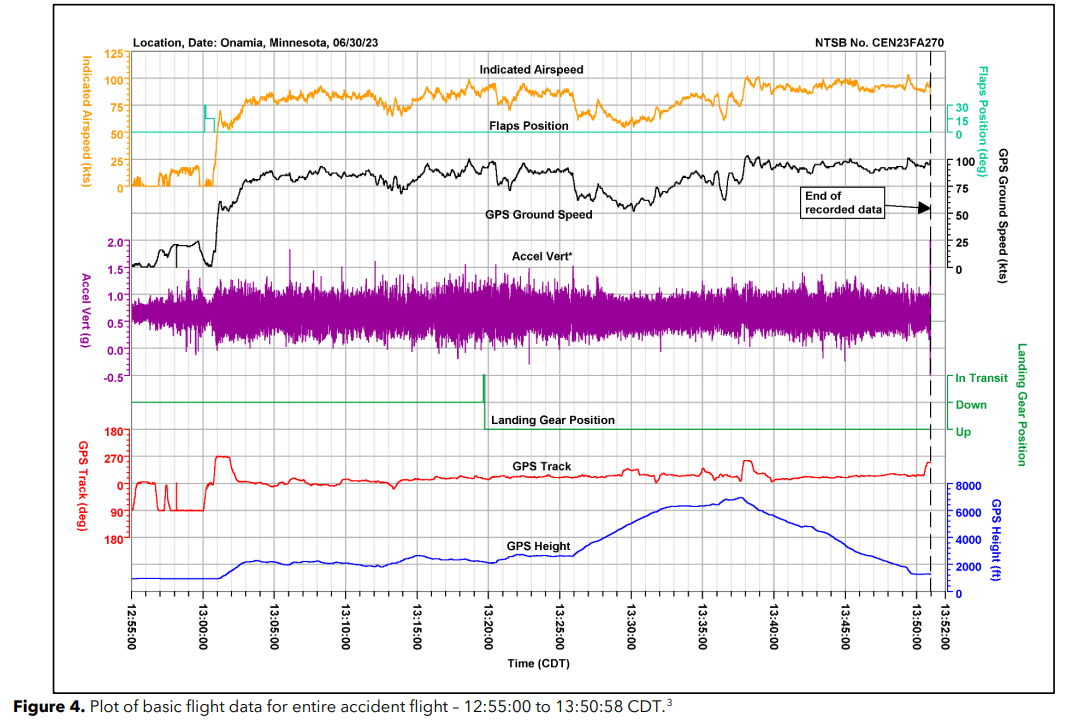
On June 30, 2023, about 1349 central daylight time, an Icon A5 airplane, N239BA, was destroyed when it was involved in an accident on Mille Lacs Lake near Onamia, Minnesota. The pilot was fatally injured. The airplane was operated as a Title 14 Code of Federal Regulations Part 91 personal flight. 

The flight of two airplanes was in cruise flight on a north heading about 50 ft above a lake when the pilots agreed to fly closer to the west shore of the lake. The pilot of the second (nonaccident) airplane initiated a climb and turned toward  he west. In his peripheral vision, he noticed a splash and thought the pilot of the amphibious light sport airplane had landed on the water. He made several radio calls to the accident pilot with no response.

A witness reported seeing both airplanes fly about 30–40 ft above the surface of the water; however, they did not see the accident. The airplane was destroyed when it impacted the water and became submerged in about 26 ft of water. Examination of the wreckage indicated that the airplane impacted water in a left-wing-low attitude. Further examination revealed no evidence of preimpact failures or malfunctions that would have precluded normal operation. Damage to the propeller indicated that the engine was likely under power at the time of the accident.

The pilot’s autopsy revealed cardiovascular disease that would have increased his risk of experiencing a sudden impairing or incapacitating cardiac event, such as arrhythmia, chest pain, or heart attack. There was no autopsy evidence that such an event occurred; however, such an event does not leave reliable autopsy evidence if it occurs shortly before death.

Toxicology results indicated that the pilot had used a cannabis product. However, the precise timing of his last cannabis use, and whether it caused significant impairing effects at the time of the accident, could not be determined from the measured levels of delta-9-THC and its metabolites.

- Probable Cause: The pilot’s failure to maintain clearance from the water while flying at a low altitude.

Monday, June 23, 2025

Honda HA-420 HondaJet, N225HJ, accident occurred on May 18, 2023, at Summerville Airport (DYB/KDYB), Summerville, South Carolina

  • Location: Summerville, South Carolina 
  • Accident Number: ERA23FA235 
  • Date & Time: May 18, 2023, 00:14 Local 
  • Registration: N255HJ 
  • Aircraft: HONDA AIRCRAFT CO LLC HA-420 
  • Aircraft Damage: Substantial 
  • Defining Event: Runway excursion 
  • Injuries: 6 None 
  • Flight Conducted Under: Part 91: General aviation - Personal 

https://data.ntsb.gov/carol-repgen/api/Aviation/ReportMain/GenerateNewestReport/180442/pdf

https://data.ntsb.gov/Docket?ProjectID=180442

On May 18, 2023, about 0014 eastern daylight time, a Honda Aircraft Company HA-420, N225HJ, was substantially damaged when it was involved in an accident at Summerville Airport (DYB), Summerville, South Carolina. The commercial pilot and five passengers were not injured. The airplane was operated as a Title 14 Code of Federal Regulations Part 91 personal flight.

The pilot was attempting to land on a wet, 5,000-ft-long asphalt runway in night conditions with calm wind. He stated that the airplane touched down before the 1,000 ft markers and that he immediately applied full brake pressure. The brakes began to cycle in anti-skid mode, but the pilot said the cycling felt slower than normal. The pilot considered a go-around, but the left brake “grabbed” suddenly, and the airplane yawed left and began a sequence of left and right skids before it continued off the end of the runway. The airplane traveled down an embankment onto a rocky berm and came to rest about 360 ft from the end of the runway. The pilot and the passengers egressed the airplane uninjured before a post-impact fire consumed the cockpit, center fuselage, and the right wing.

The pilot stated that he used the airplane’s cockpit display unit (CDU) computer to calculate the airplane’s landing reference speed (Vref) of 120 knots (kts) and reported that the airplane touched down at this speed. Although recorded data for the flight was not available due to thermal damage to the avionics, ADS-B data last captured the airplane on final approach at a groundspeed of 120 kts, about 200 ft above the runway, consistent with the pilot’s statement. However, when the conditions that existed at the time of the accident were entered into an exemplar CDU, the calculated Vref was 112 kts, and the required landing distance for a wet/contaminated runway was 4,829 ft.

To determine the landing distance required at a Vref of 120 kts, a Vref increment of Vref+5 (117 kts) and Vref+10 (122 kts) were entered into the CDU; the results were 5,311 ft and 5,794 ft, respectively. When these landing distances were calculated, the CDU, which had already been programmed for a 5,000-ft-long runway, displayed a prominent caution below the Vref number that stated: “LANDING FIELD LENGTH INSUFFICIENT.” How the accident pilot achieved a Vref of 120 kts via the CDU based on the conditions that existed at the time of the accident could not be determined.

Postaccident examination of the braking system revealed no evidence of any preimpact anomalies or malfunctions that would have precluded normal operation; however, a testing anomaly was observed when the power brake and antiskid valve were tested. An initial test on an exemplar bench stand produced hysteresis that could not be produced when it was tested on a certified bench at the manufacturer. According to the manufacturer, the anomaly observed would not prevent the application of brakes nor the removal of pressure during skidding events; however, significant hysteresis may lead to braking performance degradation due to a decreased pressure application for a given current input. The reason for the anomaly was unknown, and therefore, it could not be determined if it played a role in the loss of braking action reported by the pilot.

Despite this anomaly, and based on all other available information, the pilot landed the airplane faster than the prescribed landing speed with insufficient runway length available given the wet runway condition, which resulted in a runway excursion.

- Probable Cause: The pilot’s improper calculation of the airplane’s landing approach speed and required landing distance, which resulted in the airplane touching down fast with inadequate runway available, and a subsequent runway excursion.

Beechcraft V35A-TC Bonanza, N8074R, accident occurred on June 1, 2023, at Statesboro Bulloch County Airport (TBR/KTBR), Statesboro, Georgia

https://data.ntsb.gov/carol-repgen/api/Aviation/ReportMain/GenerateNewestReport/192287/pdf

https://data.ntsb.gov/Docket?ProjectID=192287

On June 1, 2023, about 1455 eastern daylight time, a Beech V35A, N8074R, was substantially damaged when it was involved in an accident at the Statesboro County Airport (TBR), Statesboro, Georgia. The pilot received minor injuries. The airplane was operated as a Title 14 Code of Federal Regulations Part 91 personal flight.

The pilot reported that the purpose of the flight was to test the newly installed autopilot servos and calibrate the fuel flow sensor. The pilot stated that the control surfaces moved as expected during the preflight inspection. Near the end of the flight, the autopilot did not turn to a programmed waypoint. The pilot disconnected the autopilot and took over manual control of the airplane but was unable to prevent an unintended nose-down pitch. Despite verifying the autopilot disconnection, the yoke was unresponsive and the airplane continued to descend on the final approach, striking a light pole about 1,000 ft short of the runway threshold before impacting the ground.

Postaccident examination of the airplane revealed that the pitch servo bridle cable clamp had not been properly installed, which resulted in the cable binding when the yoke was pulled aft. The installer had not verified that the required clearance was maintained and did not perform the necessary post-installation control movement checks as specified in the autopilot’s installation instructions. The incorrect positioning of the bridle cable clamp resulted in restricted elevator control, which prevented the pilot from recovering from the nose-down condition during the approach.

- Probable Cause: Maintenance personnel’s improper installation of the pitch servo bridle cable clamp, which led to binding in the elevator control system that restricted aft yoke movement during the landing approach.

Schweizer 269C (300C), N9WZ, accident occurred on July 1, 2023, near Macclenny, Florida

  • Location: Macclenny, Florida 
  • Accident Number: ERA23LA284 
  • Date & Time: July 1, 2023, 12:00 Local 
  • Registration: N9WZ 
  • Aircraft: Schweizer 269C 
  • Aircraft Damage: Substantial 
  • Defining Event: Ground resonance 
  • Injuries: 1 Minor, 2 None 
  • Flight Conducted Under: Part 91: General aviation - Aerial observation

https://data.ntsb.gov/carol-repgen/api/Aviation/ReportMain/GenerateNewestReport/192513/pdf

https://data.ntsb.gov/Docket?ProjectID=192513

On July 1, 2023, about 1200 eastern daylight time, a Schweizer 269C helicopter, N9WZ, was substantially damaged when it was involved in an accident near Macclenny, Florida. The commercial pilot sustained minor injuries and two passengers were not injured. The helicopter was operated as a Title 14 Code of Federal Regulations Part 91 personal flight.

According to the pilot, he flew the helicopter to the accident site earlier in the day with no anomalies noted during the preflight inspection, the flight itself, and the post-flight inspection. He said he briefed and loaded two passengers, which placed the helicopter near its maximum allowable gross weight and near its forward center-of-gravity (CG) limit. The pilot attempted the engine start but “inadvertently stalled the engine” during main rotor engagement. After the rotor stopped, he performed an engine start, rotor engagement, run-up, and a “ground check with no defects noted.”

The pilot said when he started to raise the collective control for takeoff, he felt a “very slight vibration that subsided instantly” but he lowered the collective, performed a magneto check, checked the gauges, felt for any vibration, and listened for any malfunction. Everything seemed normal so he initiated the takeoff again.

The pilot reported that as he began to raise the collective an “extremely violent” left-to-right rocking motion began. The pilot considered lifting the helicopter into the air in case the helicopter was in ground resonance, but he believed that the helicopter had experienced “a major malfunction and not ground resonance.” He lowered the collective, reduced the throttle to idle, and the helicopter, which had not left the ground, “disintegrated.”

A witness recorded a 21-second video that showed the seconds before the accident and the accident itself. Sounds consistent with engine and main rotor operating rpm were heard before both rpm signatures appeared to droop as the helicopter became light on the skids and rotated nose-left around the main rotor mast about 20° before it settled to the ground. The helicopter then instantaneously rocked left and right, the main transmission and mast assembly became free of its mounts, and the turning main rotor destroyed the tailboom. A detailed examination of the wreckage and the  aintenance records revealed damage consistent with a ground resonance event, and damage/degradation of main rotor elastomeric dampers and the landing gear dampers that predated the event. It is likely that the degraded condition of the dampers accelerated the helicopter's entry into ground resonance during the pilot's takeoff attempt. The records also revealed improper maintenance and missing entries for mandatory inspections.

The sequence of events, the observed pattern of the helicopter’s self-destruction, and the damage signatures were all consistent with ground resonance. The loading of the helicopter near its maximum gross weight and the relatively high density altitude additionally compromised the control and power margins available to the pilot during the attempted takeoff.

- Probable Cause: The improper maintenance of the landing gear dampers and main rotor elastomeric dampers, resulting in ground resonance during an unsuccessful takeoff attempt with the helicopter near its maximum gross weight for the density altitude.

Beechcraft C35 Bonanza, N620D, accident occurred on July 20, 2023, near Southwest Wyoming Regional Airport (RKS/KRKS), Rock Springs, Wyoming


  • Location: Rock Springs, Wyoming 
  • Accident Number: WPR23LA283 
  • Date & Time: July 20, 2023, 12:55 Local 
  • Registration: N620D 
  • Aircraft: Beech C35 
  • Aircraft Damage: Substantial 
  • Defining Event: Loss of engine power (partial) 
  • Injuries: 2 Minor 
  • Flight Conducted Under: Part 91: General aviation - Personal

https://data.ntsb.gov/carol-repgen/api/Aviation/ReportMain/GenerateNewestReport/192689/pdf

https://data.ntsb.gov/Docket?ProjectID=192689

On July 20, 2023, about 1255 mountain daylight time, a Beech C35 airplane, N620D, was substantially damaged when it was involved in an accident near Rock Springs, Wyoming. The pilot and passenger sustained minor injuries. The airplane was operated as a Title 14 Code of Federal Regulations Part 91 personal cross-country flight.

The pilot was conducting a personal cross-country flight in the single-engine airplane when the accident occurred. During the flight the pilot and passenger heard a pop sound from the engine. The passenger thought he saw something fly up from the engine and they subsequently saw some residue stuck on the windshield. The passenger described it as five small black specs of a thick viscosity. A few minutes later the airplane could not maintain altitude and the engine rpm had a slight drop even though all of the engine indications were still in the green. The pilot decided to continue to his destination airport. After maneuvering at the destination airport, the maximum engine rpm decreased to 1,250 rpm. The pilot declared an emergency and switched runways; however, due to airport ground traffic, he decided to land off airport. The airplane contacted powerlines and the ground during the landing.

Examination of the wreckage revealed that the propeller pitch control bearing forward cage and ball bearings had separated and were not found with the wreckage. The bearing inner and outer races were covered in a dark residue. The castellated nuts on the actuator bearing assembly remained attached to the pitch change bolts. However, the nut on the No. 1 pitch control rod had backed out of place and sustained mechanical damage. A cotter pin was not found in the nut. The nut on the No. 2 pitch control rod remained in place and a cotter pin was installed in the nut. The damaged nut was positioned adjacent to the propeller pitch control bearing assembly. The actuator bearing assembly was positioned unevenly on the hub assembly.

Based on this evidence, the damaged castellated nut was likely not properly installed with a cotter pin. The missing cotter pin allowed the nut to back off to the end of the pitch change bolt, resulting in contact and catastrophic damage to the propeller pitch control bearing. It is likely that the unevenly positioned pitch control rods resulted in a reduction of RPM and thrust.

The actuator bearing assembly was removed from the hub; the attachment hole and surrounding area for the No. 1 pitch control rod was covered in a dark oily residue. The No. 2 pitch control rod attachment hole showed clean surfaces. Therefore, the No. 1 pitch control rod was likely loose for some time, resulting in the dark oil residue in the attachment area.

- Probable Cause: Maintenance personnel’s failure to properly secure the propeller pitch control rod castellated nut hardware, which resulted in an in-flight failure of the pitch control bearing and subsequent loss of engine RPM and thrust.