Friday, June 13, 2025

Cessna 550 Citation II, N627HS, accident on March 19, 2025, at Hilton Head Airport (HHH/KHXD), Hilton Head Island, South Carolina

This is preliminary information, subject to change, and may contain errors. Any errors in this report will be corrected when the final report has been completed.

https://data.ntsb.gov/carol-repgen/api/Aviation/ReportMain/GenerateNewestReport/199958/pdf

https://registry.faa.gov/AircraftInquiry/Search/NNumberResult?nNumberTxt=N627HS
  • Location: Hilton Head Island, SC 
  • Accident Number: ERA25LA165 
  • Date & Time: March 19, 2025, 14:45 Local 
  • Registration: N627HS Aircraft: Cessna S550 
  • Injuries: 2 None 
  • Flight Conducted Under: Part 91: General aviation - Personal

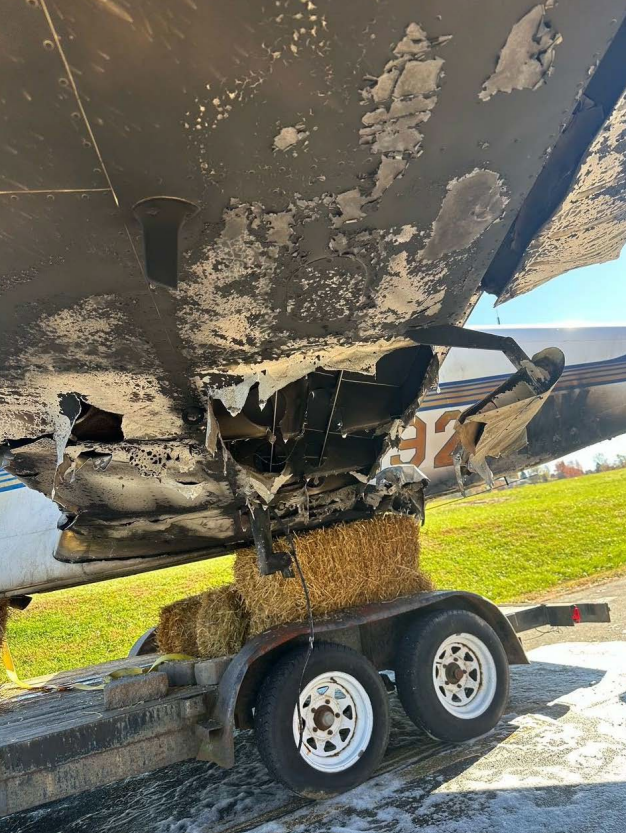
On March 19, 2025, about 1445 eastern daylight time, a Cessna S550 airplane, N627HS, was substantially damaged when it was involved in an accident near Hilton Head Island, South Carolina. The airline transport pilot and passenger were not injured. The airplane was being operated as a Title 14 Code of Federal Regulations Part 91 personal flight.


According to the pilot, the airplane departed from Conway-Horry County Airport (HWY), Conway, South Carolina, and the enroute portion of the flight was uneventful. The pilot subsequently established the airplane on a stabilized approach to Hilton Head Airport (HXD), Hilton Head Island, South Carolina. Upon selecting the landing gear to the down position, the three green gear safe lights illuminated, and he continued the approach. After touchdown, the nose gear collapsed as it contacted the runway. The pilot felt a bump, heard scraping, and as the airplane slowed, he turned to exit the runway.


Initial examination of the airplane by a Federal Aviation Administration inspector revealed that the nose landing gear actuator was fractured. The landing gear bay and surrounding structure was ground down into the airframe with associated bucking. The nose landing gear actuator was retained for further examination. 

Learjet 36A, N56PA, fatal accident occurred on May 10, 2023, near San Clemente Island, California

https://data.ntsb.gov/carol-repgen/api/Aviation/ReportMain/GenerateNewestReport/130456/pdf

https://data.ntsb.gov/Docket?ProjectID=130456

https://registry.faa.gov/AircraftInquiry/Search/NNumberResult?nNumberTxt=N56PA

Phoenix Air Group Inc

  • Location: San Clemente Island, California 
  • Accident Number: WPR23FA185 
  • Date & Time: May 10, 2023, 07:49 Local
  • Registration: N56PA 
  • Aircraft: GATES LEAR JET 36A 
  • Aircraft Damage: Destroyed 
  • Defining Event: Fire/smoke (non-impact) 
  • Injuries: 3 Fatal 
  • Flight Conducted Under: Part 91: General aviation - Other work use

On May 10, 2023, at 0749 Pacific daylight time, a Gates Lear Jet 36A, N56PA, was destroyed when it was involved in an accident near San Clemente Island, California. Both pilots and the additional crewmember were fatally injured. The airplane was operating as a Title 14 Code of Federal Regulations Part 91, other work use flight.


The accident airplane took off as the lead airplane in formation with a second Lear Jet airplane flying as wingman in a close formation position. The purpose of the flight was to participate in an exercise with the United States Navy in an over-water training area. 


Shortly after entering the training area at 15,000 ft mean sea level (msl) the wingman positioned on the right side of the accident airplane, observed the flaps on the accident airplane were partially extended. They notified the pilot of the accident airplane who acknowledged the radio call. The wingman then observed the flaps retract and observed white or gray colored “smoke or gas” coming from the left aft side of the airplane. The pilot in the accident airplane then radioed that they detected an odor in the cabin. Seconds later, the wingman observed red fluid on the underside of the tail cone followed by flames coming from around the aft equipment bay (tail cone) access door. They informed the accident pilots that their airplane was on fire and the accident pilot declared an emergency along with their intentions to land at a nearby airfield on the island.


The wingman took over leading the formation and maneuvered in front of the accident airplane. The wingman last observed and heard radio transmissions from the accident airplane a short time later as they descended through about 7000 ft msl. The flight was above an overcast cloud layer that obstructed the view of the island at that time.


Recorded ADS-B data showed that the accident airplane subsequently made a series of descending turns before the data ended.The airplane wreckage was located underwater about 4 miles northwest of the last ADS-B data point. The wreckage was highly fragmented, and the debris field extended several hundred feet along the ocean floor. Salvage operations were able to recover about 40 percent of the airplane wreckage.


Examination of the wreckage showed areas of smoke and fire damage in portions of the airplane from the center wing fuselage outboard through the left- and right-wing roots and aft throughout the empennage. The aft equipment bay forward bulkhead, which also served as the fuselage fuel tank aft bulkhead, exhibited   damage on the upper left side consistent with exposure to a focused heat source such as a fire from a leak in a pressurized fuel or hydraulic line. Additional evidence of focused fire damage was identified in the left engine pylon, which was located outboard and adjacent to the aft equipment bay. The effected area of the pylon contained engine fire detection circuits.


Examination of the hydraulic shutoff valves attached to the hydraulic reservoir found that the left hydraulic shutoff valve was closed and the right valve was in the open position. The position of the left hydraulic shutoff valve indicates the aircrew likely shut down the left engine due to a fire indication (A hydraulic valve will close if the FIRE PULL tee-handle switch is activated by the flight crew in the event an engine fire is detected). Investigators were unable to determine if the witnessed flap extension and retraction was initiated by activation of the flap selector switch or induced by fire damage.


The aft equipment bay houses electrical equipment capable of providing an ignition source for a fire, and hydraulic and fuel system components capable of providing fuel for a fire in the event of a leak. The left fuel motive flow line was intact from the fuel pump up to the fuselage fitting, where the line passes through the fuselage skin into the aft equipment bay near the aft left engine mount. The fuselage fitting had the stainless-steel fuel line and b-nut attached on the outboard, engine side. The inboard, aft equipment bay side of the fitting did not have an aluminum b-nut attached or the line that connects the fitting to the motive flow valve. The left engine hydraulic pressure line and PT2 line, which pass through the fuselage into the aft equipment bay adjacent to the motive fuel line, each had aluminum b-nuts present on the interior side of their respective fuselage fittings and the interior lines for each was sheared at the fitting. 


The left fuel motive flow fuselage fitting and the hydraulic fluid return fitting were examined. No thermal damage was observed on the outboard nuts and attached portions of tubing. Examination of the threads on the inboard side of the motive flow fitting did not exhibit evidence of thread stripping and comparison between the two fittings did not reveal any physical differences to explain why one nut remained attached and the other did not. The reason the motive flow nut was missing from the fitting could not be determined.


Observed fire and heat damage patterns indicate the fire likely started in proximity to the where the pressurized fuel motive flow line connected to the firewall fitting where the missing b-nut was located. A leak from the pressurized motive flow line would have sustained and allowed an uncontrollable fire to develop. The sustained fire likely affected controllability of the airplane and resulted in the pilots’ loss of control of the airplane.


- Probable Cause: The pilots’ loss of airplane control following a catastrophic fire that started on the left side of the aft equipment bay (tail cone). The fire likely initiated from a leak from the left fuel motive flow line due to a b-nut that loosened for reasons that could not be determined based on available evidence.

Thursday, June 12, 2025

Miscellaneous/other: Evolution Revo, N889HT, fatal accident occurred on September 25, 2024, near Zephyrhills Municipal Airport (ZPH/KZPH), Zephyrhills, Florida


https://data.ntsb.gov/carol-repgen/api/Aviation/ReportMain/GenerateNewestReport/195191/pdf

https://data.ntsb.gov/Docket?ProjectID=195191

https://registry.faa.gov/AircraftInquiry/Search/NNumberResult?nNumberTxt=N889HT

  • Location: Zephyrhills, Florida 
  • Accident Number: ERA24FA395 
  • Date & Time: September 25, 2024, 07:10 Local 
  • Registration: N889HT 
  • Aircraft: EVOLUTION AIRCRAFT INC REVO 
  • Aircraft Damage: Destroyed 
  • Defining Event: Miscellaneous/other 
  • Injuries: 2 Fatal 
  • Flight Conducted Under: Part 91: General aviation - Instructional 


On September 25, 2024, about 0710 eastern daylight time, an Evolution Aircraft Inc. Revo weight-shift-control aircraft, N889HT, was destroyed when it was involved in an accident near Zephyrhills, Florida. The flight instructor and student pilot were fatally injured. The aircraft was operated as a Title 14 Code of Federal Regulations Part 91 instructional flight.


The accident occurred during an instructional flight in a weight-shift-control aircraft. A witness reported hearing a popping sound and then saw the aircraft descending in a nose-down attitude with what he thought were flames coming from the aircraft. The aircraft continued to descend and impacted on the terrain. An airport security video captured the aircraft in a nosedown attitude with the wings folded back as it descended. The video showed that in the early morning, low light conditions, the aircraft’s position lights were on. This was likely what the witness thought was flames coming from the aircraft. Postaccident examination of the wreckage confirmed that there was no evidence of an inflight fire; however, a postimpact fire consumed most of the wreckage.


The examination also found that the flight control cables were all connected to their respective connections. The haul back cable was found disconnected at the “J” hook, and the “J” hook was otherwise intact. The haul back cable allowed the wings to be folded for transport and storage of the aircraft. An inflight disconnection would have allowed the wings to fold back during flight. Based on this information, it is likely that the flight instructor did not secure the end of the haul back cable into the “J” hook prior to departing and the haul back cable detached during flight, which allowed the wings to fold up.


- Probable Cause: The flight instructor’s failure to ensure the haul back cable was securely connected to the “J” hook prior to departing on the accident flight, which resulted in the cable becoming disconnected and the wings folding up during flight.

Cabin safety event: Eurocopter EC 130T2 (ACH130 Aston Martin), N254DM, acicdent occurred on May 6, 2023, near Carta Valley, Texas


https://data.ntsb.gov/carol-repgen/api/Aviation/ReportMain/GenerateNewestReport/122569/pdf

https://data.ntsb.gov/Docket?ProjectID=122569

https://registry.faa.gov/AircraftInquiry/Search/NNumberResult?nNumberTxt=N254DM

  • Location: Carta Valley, Texas
  • Accident Number: CEN23LA178
  • Date & Time: May 6, 2023, 16:00 Local
  • Registration: N254DM
  • Aircraft: Airbus Helicopters EC130
  • Aircraft Damage: None
  • Defining Event: Cabin safety event
  • Injuries: 1 Serious, 3 None
  • Flight Conducted Under: Part 91: General aviation - Aerial observation
On May 6, 2023, about 1605 central daylight time, an Airbus Helicopters EC-130T2 helicopter, N254DM, sustained no damage when it was involved in an accident near Carta Valley, Texas. The pilot and two passengers sustained no injuries and one passenger sustained serious injuries. The helicopter was operated as a Title 14 Code of Federal Regulations Part 91 aerial observation flight.


The helicopter departed for a low-level flight to perform aerial hunting of wild pigs on a remote ranch. During the flight, several herds of wild pigs were located and were engaged by the two rear-seat passengers. Shortly after, the pilot brought the helicopter to an out-of-ground effect hover, about 50 ft above ground level (agl), and assessed that the helicopter needed to be refueled. The helicopter was slowly moving forward during the hover when the left rear-seat passenger observed, from the “corner of his eye” as he was turning his head, the right rear-seat passenger depart the helicopter. Just before departing the helicopter, the right rear-seat passenger was facing forward. He then turned his body about 90° to the right facing out of the helicopter, he stepped on the pedestal mounted on the right skid, stood up, and then took a step forward.


The left rear-seat passenger notified the pilot about what he observed, and the pilot landed the helicopter. The injured passenger was unconscious with serious injuries. The injured passenger was loaded onto the helicopter, both cabin doors were closed, and the helicopter departed. The passenger was transported for medical treatment. The helicopter was not damaged.


The passenger did not provide a statement to the NTSB.


The helicopter owner reported that while in the out-of-ground effect hover, the passenger may have thought the helicopter was near the ground when he decided to depart the helicopter. The helicopter owner also reported that there were no preimpact mechanical malfunctions or failures with the airframe or the engine that would have precluded normal operation.


Postaccident examination of the right rear passenger seat and restraint system did not reveal any preimpact mechanical malfunctions or failures that would have precluded normal operation. Postaccident download of the accident flight engine data showed normal engine performance.


Toxicological evidence indicates that the injured passenger had consumed alcohol before the accident. Hospital testing measured a serum ethanol level of 0.067 g/dL about 2.6 hours after the accident. During the flight, the injured passenger was quiet, did not do or say anything abnormal, and did not appear to have been intoxicated. Based on this evidence, the injured passenger was likely experiencing impairing ethanol effects at the time of the accident. Such effects likely included worsened perception, judgment, and/or coordination that increased the likelihood of an accident. Thus, the injured passenger’s alcohol impairment likely contributed to his improper judgment to release his restraint system and depart the helicopter while in a hover.


- Probable Cause: The right rear-seat passenger’s improper judgement to release his restraint system and depart the helicopter while in a hover, which resulted in him sustaining serious injuries. Contributing to the accident was his impairment from effects of alcohol consumption.

Loss of control in flight: Piper PA-28-140 Cherokee D, N926MK, accident occurred on October 27, 2024, at Fairmont Municipal Airport-Frankman Field (4G7), Fairmont, West Virginia

https://data.ntsb.gov/carol-repgen/api/Aviation/ReportMain/GenerateNewestReport/195387/pdf

https://data.ntsb.gov/Docket?ProjectID=195387

https://registry.faa.gov/AircraftInquiry/Search/NNumberResult?nNumberTxt=N926MK


  • Location: Fairmont, West Virginia 
  • Accident Number: ERA25LA025 
  • Date & Time: October 27, 2024, 11:30 Local 
  • Registration: N926MK 
  • Aircraft: Piper PA28 
  • Aircraft Damage: Substantial 
  • Defining Event: Loss of control in flight 
  • Injuries: 1 None
  • Flight Conducted Under: Part 91: General aviation - Instructional

On October 27, 2024, at 1130 eastern standard time, a Piper PA-28-140, N926MK, was substantially damaged when it was involved in an accident near Fairmont, West Virginia. The student pilot was not injured. The airplane was operated as a Title 14 Code of Federal Regulations Part 91 instructional flight.


The student pilot reported that after a successful first landing, he attempted a second landing but initiated a go-around due to the airplane being high on final approach. On the second attempt, he noted that the wind velocity had increased. During the landing, the airplane bounced and was pushed to the left. Despite corrective inputs, the airplane veered off the runway, impacted a guardrail, and a postimpact fire ensued. The pilot reported that there were no preimpact mechanical malfunctions or failures of the airplane that would have precluded normal operation.


- Probable Cause: The student pilot’s improper flare, which resulted in a bounced landing and subsequent loss of directional control.

Unknown or undetermined: Magni M24 Orion Plus, N1777W, accident occurred on May 30, 2023, near Dauphine Island, Alabama


https://data.ntsb.gov/carol-repgen/api/Aviation/ReportMain/GenerateNewestReport/192273/pdf

https://data.ntsb.gov/Docket?ProjectID=192273

https://registry.faa.gov/AircraftInquiry/Search/NNumberResult?nNumberTxt=1777W

  • Location: Dauphin Island, Alabama 
  • Accident Number: ERA23LA251 
  • Date & Time: May 30, 2023, 11:01 Local 
  • Registration: N1777W 
  • Aircraft: MAGNIFLIGHT LLC M24 ORION PLUS 
  • Aircraft Damage: Substantial 
  • Defining Event: Unknown or undetermined 
  • Injuries: 2 None 
  • Flight Conducted Under: Part 91: General aviation - Personal

On May 30, 2023, at 1101 central daylight time, a Magniflight M24 Orion Plus gyroplane, N1777W, was involved in an accident near Dauphine Island, Alabama. The pilot and the passenger were not injured. The flight was conducted as a 14 Code of Federal Regulations Part 91 personal flight.


The pilot of the gyroplane reported several lane warnings during the flight, which indicated possible disruptions to the fuel/ignition timing by the engine’s digital engine control unit (ECU). The ECU was comprised of two modules that worked in sync with each other to monitor numerous sensors throughout the engine. Although the pilot tried to reset the lane warning several times, the engine lost partial power. The pilot was unable to maintain altitude and made a forced landing in tall grass, during which the gyroplane rolled over and substantial damage.


A postaccident examination and test run of the engine revealed no obvious mechanical malfunctions or failures that would have contributed to the accident. Data downloaded from the engine’s digital ECU and an electronic flight information system (EFIS) revealed that, at the time of the partial loss of engine power, the exhaust gas temperature (EGT) reading for the No. 4 cylinder dropped to levels indicating that combustion was no longer occurring within the cylinder. The loss of combustion in the No. 4 cylinder likely resulted in the partial power loss of the engine.


The cause of the loss of combustion in the No. 4 cylinder could not be determined with the available engine ECU and EFIS data. Along with the engine data, the fact that the engine ran after the accident indicated there was likely an intermittent issue with the fuel/air delivery or the ignition to the No. 4 cylinder that could not be duplicated.


- Probable Cause: A partial loss of engine power due to a loss of combustion in the No. 4 cylinder for undetermined reasons.

Collision with terr/obj (non-CFIT): Piper PA-22-160 Tri-Pacer, N4NW, accident occurred on August 29, 2025, near Aleknagik, Alaska

https://registry.faa.gov/AircraftInquiry/Search/NNumberResult?nNumberTxt=N4NW

https://data.ntsb.gov/carol-repgen/api/Aviation/ReportMain/GenerateNewestReport/195025/pdf

  • Location: Aleknagik, Alaska
  • Accident Number: ANC24LA083
  • Date & Time: August 29, 2024, 19:00 Loca
  •  Registration: N4NW
  • Aircraft: Piper PA22
  • Aircraft Damage: Substantial
  • Defining Event: Collision with terr/obj (non-CFIT)
  • Injuries: 3 None
  • Flight Conducted Under: Part 91: General aviation - Personal

According to the pilot, while conducting a low altitude pass over an off-airport site with a 5 to 7 mph tailwind in his tailwheel-equipped airplane, the landing gear contacted a patch of alder brush. The airplane subsequently came to rest in an area of tall brush, both wings, lift struts and empennage sustained substantial damage. The pilot reported no pre-impact mechanical malfunctions or failures with the airplane that would have precluded normal operation.


- Probable Cause: The pilot’s failure to maintain clearance from terrain while maneuvering at low altitude.