Saturday, June 21, 2025

Landing area overshoot: Cessna R182 Skylane RG, N738PG, accident occurred on November 18, 2024, at A J Patrol Airport (LS09), Crowley, Louisiana

  • Location: Crowley, Louisiana
  • Accident Number: CEN25LA045
  • Date & Time: November 18, 2024, 14:35 Local
  • Registration: N738PG Aircraft: Cessna R182
  • Aircraft Damage: Substantial
  • Defining Event: Landing area overshoot
  • Injuries: 1 None
  • Flight Conducted Under: Part 91: General aviation - Business

https://data.ntsb.gov/carol-repgen/api/Aviation/ReportMain/GenerateNewestReport/195502/pdf

https://data.ntsb.gov/Docket?ProjectID=195502

The pilot reported that he was returning from a pipeline patrol flight and was landing to the south on the north-south oriented grass runway which was wet from recent rain. He said that upon touchdown the airplane “yanked” to the left and began sliding on the wet grass. He could not stop the airplane because of the reduced braking action due to the wet runway. The airplane impacted a hangar located at the south end of the runway and the right wing sustained substantial damage.

The operator reported that he had witnessed the accident. He noted that the weather conditions were getting worse and were approaching instrument meteorological conditions. He saw the airplane approach from the north to land to the south on the north-south oriented runway. Initially the airplane was lined up on a field to the east of the runway and he then saw the airplane attempt to turn and line up with the runway. He noted that the airplane appeared lower and faster than normal. After the airplane turned toward the runway, it touched down about halfway down the 2,500 ft. runway and was about 45° from runway alignment. The airplane then started to skid sideways on the wet grass. The airplane tires then regained grip and the airplane darted to the side and impacted the hangar at the south end of the runway. The operator stated that the pilot did not report any problem with the rudder trim system either before or after the accident.

Well after the accident, the pilot stated that the rudder trim on the airplane was not operating correctly, and the skid slip ball was not centered during the flight. He said the rudder trim wheel had no tension. He reported no other mechanical issues with the airplane. The pilot’s report of the rudder trim system issues was not provided until after the airplane was no longer available for examination of the rudder trim system. Regardless, the rudder trim should not have inhibited the pilot from maintaining directional control of the airplane while landing on the wet runway.

The reported weather conditions at a nearby airport included a broken ceiling of 700 ft. above ground level (agl), an overcast ceiling at 1,300 ft. agl, and 7 miles visibility.

- Probable Cause: The pilot’s un-stabilized landing approach and high airspeed during the approach, that resulted in touchdown with insufficient runway remaining to stop the airplane.

Hard landing: Brunner-Winkle Bird, N15641, accident occurred on November 17, 2024, at Big 'T' Airport (64GA), Senoia, Georgia:

  • Location: Senoia, Georgia 
  • Accident Number: ERA25LA055 
  • Date & Time: November 17, 2024, 13:30 Local 
  • Registration: N15641 
  • Aircraft: BRUNNER-WINKLE BIRD A 
  • Aircraft Damage: Substantial 
  • Defining Event: Hard landing 
  • Injuries: 1 None 
  • Flight Conducted Under: Part 91: General aviation - Personal

https://data.ntsb.gov/carol-repgen/api/Aviation/ReportMain/GenerateNewestReport/195533/pdf

https://data.ntsb.gov/Docket?ProjectID=195533

The pilot of the antique, bi-wing, tailwheel airplane stated that he was flying locally when he landed hard on the grass runway. The left landing gear collapsed resulting in substantial damage to the upper left wing and lower right wing. The pilot reported no preimpact mechanical malfunctions or failures with the airplane that would have precluded normal operation.

- Probable Cause: The pilot’s improper flare, which resulted in a hard landing, and landing gear collapse.

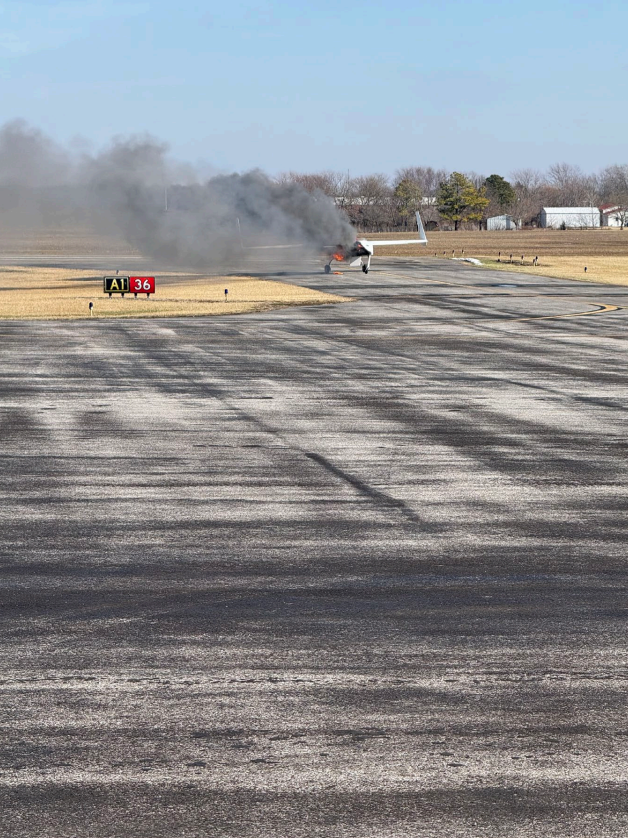
Fire/smoke (non-impact): Rutan Long-EZ, N88LE, accident occurred on February 1, 2025, at Sparta Community-Hunter Field Airport (SAR/KSAR), Sparta, Illinois

  • Location: Sparta, Illinois
  • Accident Number: CEN25LA090 
  • Date & Time: February 1, 2025, 13:50 Local 
  • Registration: N88LE 
  • Aircraft: Rutan Long-EZ 
  • Aircraft Damage: Destroyed 
  • Defining Event: Fire/smoke (non-impact) 
  • Injuries: 1 None 
  • Flight Conducted Under: Part 91: General aviation - Personal

https://data.ntsb.gov/carol-repgen/api/Aviation/ReportMain/GenerateNewestReport/199639/pdf

https://data.ntsb.gov/Docket?ProjectID=199639

The pilot reported that he taxied to the runway and performed an engine runup. During the runup, the pilot noticed that one of the magnetos was not operating properly, so he started to taxi back to his hangar. While taxing back to the hangar, he smelled burning wire insulation, and shortly after the engine stopped. He attempted to restart the engine three times. On the third restart attempt, he noticed that flames were coming out from the right wing near the fuel cap. He immediately exited the airplane and called the fire department. The airplane was destroyed by the fire.

Due to the damage caused by the fire, an examination of the airplane components to determine the source of the fire was not possible.

- Probable Cause: An onboard fire for unknown reasons.

Birdstrike: Cessna 172P Skyhawk, N5268K, accident occurred on February 2, 2025, at Ramona Airport (RNM/KRNM), Ramona, California

  • Location: Ramona, California 
  • Accident Number: WPR25LA086 
  • Date & Time: February 2, 2025, 13:00 Local 
  • Registration: N5268K 
  • Aircraft: Cessna 172P 
  • Aircraft Damage: Substantial 
  • Defining Event: Birdstrike 
  • Injuries: 2 None 
  • Flight Conducted Under: Part 91: General aviation - Personal
https://data.ntsb.gov/carol-repgen/api/Aviation/ReportMain/GenerateNewestReport/199642/pdf

https://data.ntsb.gov/Docket?ProjectID=199642

The pilot reported that while during a crosswind turn in the airport traffic pattern, about 2,000 ft mean sea level, a bird struck the airplane. Postaccident examination of the airplane revealed substantial damage to the left wing.

The pilot reported no preaccident mechanical malfunctions or failures that would have precluded normal operation. 

- Probable Cause: An in-flight collision with a bird in the airport traffic pattern.

Loss of engine power (total): Shield AI MQ-35 V-BAT, N443VA, accident occurred on April 8, 2025, at Bisbee Douglas International Airport (DUG/KDUG), Douglas, Arizona

  • Location: Douglas, Arizona 
  • Accident Number: WPR25LA135 
  • Date & Time: April 8, 2025, 14:55 Local 
  • Registration: N443VA 
  • Aircraft: Martin Uav VBAT 
  • Aircraft Damage: Substantial 
  • Defining Event: Loss of engine power (total)
  •  Injuries: 2 None 
  • Flight Conducted Under: Part 91: General aviation - Flight test

https://data.ntsb.gov/carol-repgen/api/Aviation/ReportMain/GenerateNewestReport/200022/pdf

https://data.ntsb.gov/Docket?ProjectID=200022

The operator of the unmanned aircraft system (UAS) reported that during a test flight, the throttle servo malfunction resulting in complete loss of engine power. The pilot was able to maneuver the UAS to a safe location where it impacted terrain, resulting in substantial damage to the fuselage and flight control surfaces. 

- Probable Cause: The malfunction of the throttle servo which resulted in the complete loss of engine power.

Loss of control in flight: Lockwood Super Drifter, N692BS, accident occurred on July 7, 2024, at Lafayette Municipal Airport (3M7), Lafayette, Tennessee

  • Location: Lafayette, Tennessee 
  • Accident Number: ERA24LA296 
  • Date & Time: July 7, 2024, 16:35 Local 
  • Registration: N692BS 
  • Aircraft: MISSOULA AVIATION LLC SUPER DRIFTER 
  • Aircraft Damage: Substantial 
  • Defining Event: Loss of control in flight
  • Injuries: 1 Serious, 1 None 
  • Flight Conducted Under: Part 91: General aviation - Personal
https://data.ntsb.gov/carol-repgen/api/Aviation/ReportMain/GenerateNewestReport/194631/pdf

https://data.ntsb.gov/Docket?ProjectID=194631

The pilot and passenger reported that during the final approach to land, an unexpected gust of wind pushed the airplane toward the west side of the runway, near the precision approach path indicator lights and a hillside. As the pilot initiated a go-around, a stronger gust lifted the right wing, and the airplane rolled to the left. The airplane then encountered an aerodynamic stall while banked about 45 degrees, which continued to a 90-degree bank with a 45-degree nosedown pitch attitude. Due to the low altitude, the pilot was unable to recover, and the airplane impacted the airport ramp area, coming to rest inverted. The pilot was seriously injured and the airplane’s wings and fuselage were substantially damaged. The pilot reported that there were no pre-impact mechanical malfunctions or failures of the airplane that would have precluded normal operation.

- Probable Cause: The pilot's failure to maintain control of the airplane during a go-around in gusting wind conditions.

Turbulence encounter: Airbus A350-941, N576DZ, accident occurred on August 29, 2023, near Atlanta, Georgia

  • Location: Atlanta, Georgia
  • Accident Number: DCA23FA428 
  • Date & Time: August 29, 2023, 22:31 UTC 
  • Registration: N576DZ 
  • Aircraft: AIRBUS SAS A350-941 
  • Aircraft Damage: Minor 
  • Defining Event: Turbulence encounter 
  • Injuries: 4 Serious, 13 Minor, 148 None 
  • Flight Conducted Under: Part 121: Air carrier - Scheduled
https://data.ntsb.gov/carol-repgen/api/Aviation/ReportMain/GenerateNewestReport/192959/pdf

https://data.ntsb.gov/Docket?ProjectID=192959

On August 29, 2023, about 1831 Eastern daylight time, Delta Air Lines (DAL) flight 175, an Airbus A350-941 experienced turbulence during descent into Hartsfield Jackson International Airport (ATL), Atlanta, Georgia. Of the 14 crew and 151 passengers onboard, 2 crew and 2 passengers sustained serious injuries, and 8 crew and 5 passengers sustained minor injuries. The aircraft sustained minor damage. DAL175 was a 14 Code of Federal Regulations (CFR) Part 121 scheduled international passenger flight from Milan Malpensa Airport (MXP), Milan, Italy to ATL.

Two passengers and two flight attendants received serious injuries aboard Delta Air Lines flight 175 when it encountered turbulence during descent into Hartsfield-Jackson Atlanta International Airport (ATL), Atlanta, Georgia. The flight was an international scheduled passenger flight operated as a Title 14 Code of Federal Regulation Part 121 from Milan Malpensa Airport (MXP), Ferno, Italy to ATL.

The flight crew’s performance leading up to the turbulence encounter was consistent with standard practices. The investigation evaluated the potential for crew awareness of the rapidly building cell where the flight encountered severe turbulence. The flight crew was aware and monitoring the general convective weather in the area and showed intention to deviate around other potential convective cells. However, the rapid development of cloud buildup that caused this turbulence event and the lack of precipitation associated with it, meant that the risk of turbulence was not apparent on aircraft weather radar nor on air traffic control scopes.

In anticipation of another convective cell a few minutes further down their route, the crew took steps to advise the flight attendants to secure the cabin early and the seat belt sign was illuminated. Unfortunately, the timing of the unexpected turbulence meant that cabin crew were not seated during the event, resulting in multiple injuries.

The investigation evaluated whether existing technology would have been sufficient to give the crew advance warning of the rapidly building cell. The Graphic Turbulence Guidance Nowcast (GTGN) or “Turbulence Nowcast” provides a computer-generated four-dimensional forecast related to the expected intensity of atmospheric turbulence in convection provided in eddy dissipation rate (EDR) as based on estimated vertical wind velocity or aircraft vertical acceleration to provide aircraft specific turbulence intensity values. While the accident aircraft did not have this capability, a Southwest Airlines flight immediately behind the accident flight on the route had in-situ capability and reported severe turbulence in the location where the turbulence event occurred. The GTGN can provide nowcasts corresponding to observed severity in near real time and could have alerted the flight crew earlier to secure the cabin.

- Probable Cause: The flight crew’s unintentional encounter with rapidly developing cumulus clouds which resulted in an encounter with severe convectively induced turbulence.